

Last Updated: October 31, 2026
Quick Summary
An African village painting brings warmth, story, and a sense of place to a family home, giving a room a focal point that starts conversations and shows children another culture. Choose one by measuring your wall first, then matching canvas size and scene to the room, such as a large horizontal above the sofa.
- Size wall art to about two-thirds to three-quarters of the furniture width below it.
- Hang the center of the artwork at eye level, commonly 57 to 60 inches from the floor.
- A 24x36 inch horizontal above a sideboard suits a dining room or kitchen nook.
- Ask whether a piece is an original, a handmade reproduction, or a print before buying.
- Keep the painting out of direct sunlight and dust it with a dry, soft cloth.
Table of Contents
- Why an African Village Painting Belongs in a Family Home
- What African Village House Paintings Commonly Depict
- Choosing African Village Wall Art by Room and Interior Style
- African Art for Living Room: Styling It With Modern Decor
- Materials, Craftsmanship, and Responsible Sourcing
- Framing, Care, and Long-Term Display
- Talking About the Painting With Your Family
- Bringing a Handcrafted African Village Painting Home
- Frequently Asked Questions
Why an African Village Painting Belongs in a Family Home
An African village painting brings warmth, story, and a sense of place to a family home.
A canvas of huts at dusk or a bold market scene anchors a room in a specific place and time, and often becomes the most-talked-about piece in the house.
Below, we cover what these paintings show, how to choose one, and how to care for it.
What African Village House Paintings Commonly Depict
An African village house painting captures everyday rural life: traditional huts, family compounds, and the small rituals that hold a community together.
The subjects repeat because they matter. To understand the cultural meaning behind the subjects and symbols shown in Tanzanian wall art, see our guide to cultural significance of Tanzanian wall art. You will commonly see:
- Traditional huts and thatched-roof houses set in a family compound
- Village life and daily activities, from cooking to gathering water
- Family and community togetherness, often shown around a fire or doorway
Many pieces lean on a warm, vibrant palette: ochre, terracotta, deep greens, and gold.
Choosing African Village Wall Art by Room and Interior Style
African village wall art works in almost any room, but the right piece depends on the wall, its size, and the room's existing colors. For more African wall art ideas curated for living room placement and styling, see our African wall art for living room guide. A busy market scene can overwhelm a small hallway; a quiet hut at sunset can disappear on a big, bare wall.
Start With the Wall, Not the Painting
Before you shop, measure the width of the furniture the art will hang above, the clear wall height, and the viewing distance from the main seating position.
Hang the center of the artwork at eye level, commonly 57 to 60 inches from the floor, unless furniture forces a higher placement. Above a sofa, the bottom of the frame usually sits 6 to 10 inches above the sofa back.
Living Room
This is where a village painting earns its keep as a statement piece. A large horizontal canvas, 24x36 inches at the small end, 36x48 or larger for a big wall, above the sofa anchors the seating area. Choose a scene with movement and color if the room is neutral; choose a calmer dusk or homestead scene if the room already has patterned rugs or busy textiles.
Bedroom
Bedrooms reward softer, quieter scenes: a single hut at dusk, a path through acacia trees, warm ochre and terracotta rather than high-contrast market crowds. A 16x20 or 24x30 inch canvas above a dresser or nightstand pair is often enough. Avoid heavy, dark pieces directly over the headboard.
Entryway and Hallway
Narrow walls suit vertical pieces or a grouped pair of smaller canvases. A slim 12x24 or 16x20 inch vertical of a doorway, a figure in traditional attire, or a path into the village gives the eye somewhere to travel. In a hallway, hang pieces at consistent center height.
Kids' Room and Family Spaces
A lively scene with animals, children, and market activity works well at a child's eye level, roughly 36 to 48 inches from the floor, so kids can actually see it. This is where the painting's storytelling value is highest.
Dining Room and Kitchen Nook
A market or farming scene fits the room where food is central. A 24x36 inch horizontal above a sideboard or banquette is a reliable size. Keep the palette warm, golds, greens, and terracotta, to echo wood tones and table linens.
Matching the Painting to Your Interior Style
- Modern and minimalist: let the painting be the only strong color in the room. Whites, warm woods, and natural textures around it; one woven basket or carved object to echo it, no more.
- Bohemian and layered: pair with rattan, jute, and patterned textiles, but keep patterns smaller in scale than the painting so they do not compete.
- Traditional and heritage: a simple float frame or gallery wrap in dark wood or black lets the painting hold its own against heavier furniture.
Color Coordination in Practice
Pull one or two colors from the painting into the room, a terracotta cushion, an ochre throw, a green plant pot, rather than matching everything. Matching every color makes the room feel busy and the art feel smaller. If the room has a strong existing color, choose a painting that shares one dominant hue with it and contrasts on the rest.
Grouping and Gallery Walls
If you hang more than one piece, treat the group as a single shape. A pair of 16x20 inch canvases with 2 to 3 inches between them reads as one unit; a grid of four smaller pieces works on a wide wall. Keep the center of the group at eye level and the gap between frames consistent, uneven spacing is the most common reason a gallery wall looks accidental.
Sizing the Canvas for a Living Room Wall
A common rule is to size art to about two-thirds the width of the furniture below it. For a standard 84-inch sofa, that points to a canvas roughly 48 to 56 inches wide. Measure your wall first, leave breathing room on each side, and hang the center at eye level, around 57 to 60 inches from the floor.
Here is a quick reference for matching canvas size and placement to each room.
The African Village Oil Canvas Painting →
| Room | Suggested size | Placement note |
|---|---|---|
| Living room | 24x36 inches at the small end; 36x48 or larger for a big wall | Above the sofa to anchor the seating area |
| Bedroom | 16x20 or 24x30 inch canvas | Above a dresser or nightstand pair |
| Entryway and hallway | Slim 12x24 or 16x20 inch vertical | Hang pieces at consistent center height |
| Kids' room and family spaces | Not specified | Roughly 36 to 48 inches from the floor |
| Dining room and kitchen nook | 24x36 inch horizontal | Above a sideboard or banquette |
African Art for Living Room: Styling It With Modern Decor
African art for living room settings works best when it is treated as the anchor, not an accessory. A bold village canvas can carry a neutral, modern room.
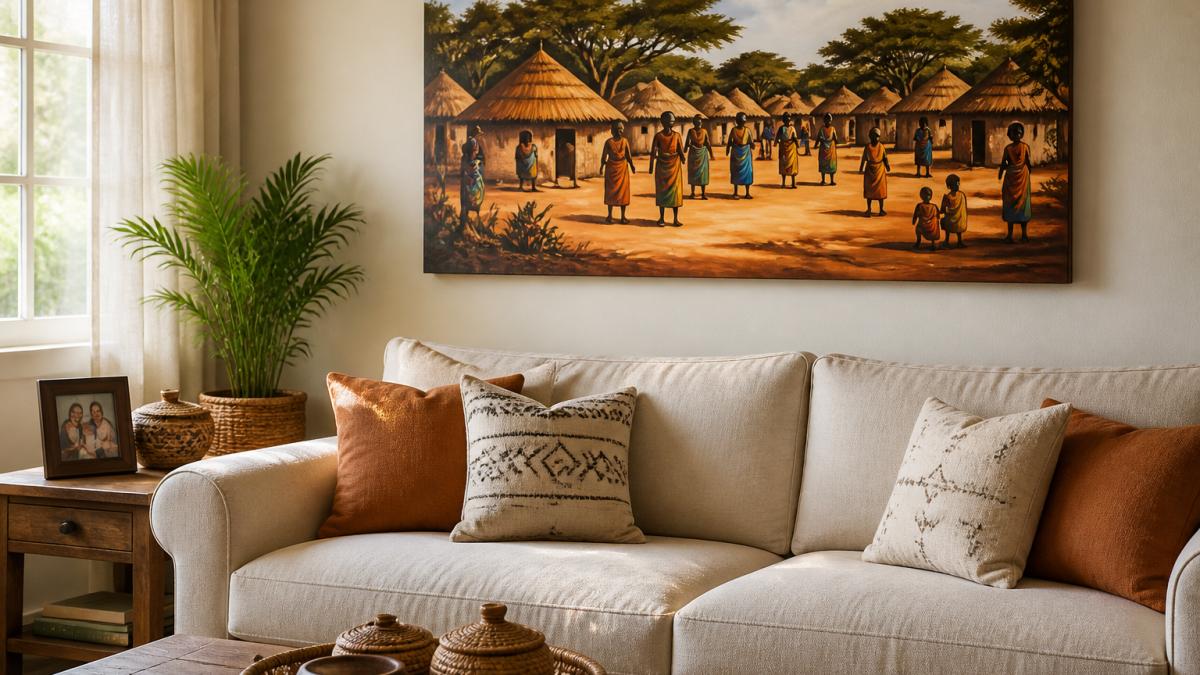
Keep the surrounding palette quiet: whites, warm woods, and natural textures. Let one or two woven or carved pieces echo the painting without competing.
For a fuller walkthrough of selecting, sizing, hanging, and caring for original canvas art in a modern interior, see our guide to African oil paintings for modern home interior design.
Materials, Craftsmanship, and Responsible Sourcing
Authenticity is where many buyers get burned. Mass-produced prints are often sold as "handcrafted," and the difference shows up close: flat color, no texture, no evidence of a human hand. Below is what you are actually buying and how to source responsibly.
Original Painting vs. Print vs. Handmade Reproduction
- Original painting: paint applied by hand to canvas or board. You should see brushwork, slight variations in pigment thickness, and canvas texture under raking light. Originals are one-of-a-kind, with visible edges where colors meet and small imperfections that read as evidence of the hand.
- Giclée or digital print: a high-quality reproduction of an existing image. Under a magnifier, the surface is a uniform dot pattern rather than brush ridges. Prints can be beautiful and affordable, but they should be labeled as prints, not sold as originals.
- Handmade reproduction or studio painting: painted by hand but based on a repeated design, often produced in a workshop. Real paint, but not a unique composition. Ask directly which category a piece falls into.
What to Look For in Materials
- Canvas: cotton duck is common; linen is more durable and more expensive. A stretched canvas should feel taut, with no sagging between the stretcher bars.
- Paint: acrylics dry fast and are widely used; oils give deeper color and slower blending but need longer curing. Neither is inherently better, ask what was used so you can care for it correctly.
- Ground and finish: a primed ground protects the canvas; a varnish layer protects the paint from dust and UV. Ask whether the piece is varnished.
How to Verify Provenance
Provenance is the documented history of a piece, who made it, where, and how it reached the seller. A seller who can describe the artist and the region is a seller worth trusting. Ask:
- Who is the artist, and where do they work?
- Is there a signature, studio mark, or certificate of authenticity?
- What region and community does the scene depict?
A certificate is not a legal guarantee, but a seller who cannot answer basic questions about the artist is a warning sign.
Responsible Sourcing in Practice
Responsible sourcing means the artist and community benefit from the sale, and the materials are what they claim to be. Our authentic Tanzanian tribal art sourcing guide explains how to verify provenance and source ethically. Look for sellers who name the artist, describe the region, and can explain how the work was acquired.
Price Signals and Red Flags
A price that seems too low for an original canvas usually means a printed reproduction, so ask directly whether the piece is an original or a print before you pay. A very high price is not proof of authenticity, provenance and visible brushwork are. Ask for close-up photos of the surface and signature, and whether returns are accepted if the piece does not match the description.
Questions to Ask Before You Buy
- Is this an original, a handmade reproduction, or a print?
- Who is the artist, and where are they based?
- What medium and canvas were used, and is it varnished?
- What region and community does the scene show?
- Can you send close-up photos of the surface and signature?
- What is the return policy if the piece differs from the photos?
A seller who answers these clearly is doing the work that responsible sourcing requires. For a fuller walkthrough of selecting, sizing, hanging, and caring for original canvas art in a modern interior, see our guide to African oil paintings for modern home interior design.
Framing, Care, and Long-Term Display
A canvas painting needs less fuss than a paper print, but a few habits keep it vivid for decades.
- Keep it out of direct sunlight, which fades pigment over time
- Avoid hanging above a heat source or in a damp bathroom
- Dust gently with a dry, soft cloth, never a wet one
A simple float frame or a clean gallery wrap lets the painting speak. Skip heavy, ornate frames that fight the artwork's color.
Talking About the Painting With Your Family
A village painting is a conversation piece, and children are natural curators of curiosity. Ask them what they notice first, then talk about what daily life might feel like in the scene: where the people are going, what the animals are doing, what the weather is like.
These small conversations build cultural awareness without a lecture and turn decor into a family story your kids may retell for years.
Bringing a Handcrafted African Village Painting Home
If you have been searching for an original piece to anchor a room, our African Village Oil Canvas Painting is available for $175.99.

Choosing art is personal, and we would rather you find the right piece than rush. Browse the canvas, picture it in your space, and reach out with any questions about the work or its origins.
Frequently Asked Questions
What should I look for when choosing an African village painting for my home?
Start with the scene itself. Look for a composition that shows daily life, such as huts, market activity, or family gatherings, rather than a generic landscape. The African Village Oil Canvas Painting is an oil canvas painting priced at $175.99. Confirm the size against your wall before buying, and ask how the piece was sourced so you know it is handcrafted rather than mass-produced.
How do I choose the right size African village wall art for a living room?
Measure the wall space above your sofa or console before choosing a piece, and allow room around the artwork for balance.
How can I tell whether an African village house painting is genuinely handcrafted?
Look for visible brushwork and slight variations in texture, which machine-printed reproductions rarely show. Ask the seller how the piece was sourced and whether it came directly from the artist or a cooperative. If a listing shows the same image at many sizes with perfectly uniform edges, treat it as a print rather than an original.
How do I care for a canvas painting at home?
Keep the canvas out of direct sunlight, which fades pigments over time, and away from heat sources like radiators or fireplaces. Dust it every few weeks with a soft, dry brush or a microfiber cloth, working gently across the surface. Never spray water or cleaning products directly onto the canvas. If you frame it, choose a frame with a small gap so air can circulate behind the canvas, and hang it on an interior wall rather than one exposed to damp.
A family home deserves art with a story behind it, not a mass-produced print. At Simcha African Safaris Limited, our curated safaris bring you face to face with the landscapes and communities that inspire these paintings, and our handcrafted art selection lets you carry that connection home. Explore our safari experiences and original pieces, then request a quote to start planning. Get started with Simcha African Safaris Limited and bring authentic African heritage into your home.


