

Last Updated: November 2, 2026
Quick Summary
Authentic tribal encounters on African safaris begin with consent, not spectacle: the community sets the terms, hosts lead the conversation, and money stays local. A genuine visit feels slower and less convenient than a staged one, with hosts deciding which areas you may enter and photograph.
- Ask before you photograph; a nod toward a camera is not consent, so wait for a clear yes.
- A community visit on safari usually lasts two to four hours, and two hours is a reasonable minimum.
- Village entry fees are set by the community and usually paid in cash, so confirm the amount and recipient beforehand.
- Do not hand out sweets or pens to children, as it builds a begging habit and undermines parents.
- Choose the operator who can describe the community's role in designing the visit, not just the itinerary.
Table of Contents
- What Makes Tribal Encounters Authentic
- Ethical Cultural Encounters in Africa: A Visitor Code of Conduct
- Tanzania Cultural Experiences: Top Tribes to Visit
- Community Visits on Safari: What to Expect
- Photography Ethics in Tribal Communities
- Cultural Safari Cost: Budget vs. Luxury Impact
- Combining Wildlife Safaris with Cultural Immersion
- Request a Quote for Your Cultural Safari
- Frequently Asked Questions
What Makes Tribal Encounters Authentic
Authentic tribal encounters on African safaris begin with consent, not spectacle. A genuine visit is one where the community sets the terms, hosts lead the conversation, and money stays local.
The difference shows up fast. A staged visit runs on a schedule built for cameras: dances timed to your arrival, a market stall opened only for tourists, children coached to pose.
Signs of a Genuine Visit vs. a Staged One
Genuine cultural immersion has markers you can check before you book:
- Hosts decide which areas you may enter and photograph
- A translator or guide from the community, not just your driver, leads the exchange
- Payment goes to a village fund, cooperative, or family, and you can ask how
A staged encounter reverses each one. If every moment is choreographed and no one says no, you are watching a product, not a culture.
Ethical Cultural Encounters in Africa: A Visitor Code of Conduct
Ethical cultural encounters in Africa rest on one principle: you are a guest in someone's home, not a customer buying a show. The code below is the one we hand to every traveler before a village visit.
- Ask before you photograph. A nod toward a camera is not consent. Wait for a clear yes.
- Dress modestly. Covered shoulders and knees read as respect in most rural communities.
- Buy directly when you can. Handicrafts purchased from the maker keep value in the household.
- Do not hand out sweets or pens to children. It builds a begging habit and undermines parents.
- Accept refusals. A closed door, a waved hand, or a quiet "no" ends the request.
- Pay the agreed fee without haggling. Bargaining over a village entry fee insults your hosts.
- Learn three words of greeting. The attempt matters more than the accent.
Respecting Traditional Customs and Etiquette
Customs vary by community, so ask your guide what applies before you arrive.
For a deeper walkthrough of specific village protocols, read our Maasai village etiquette guide. It covers greetings, gift-giving, and the questions visitors most often get wrong.
Watch out: treating a cultural visit as a photo opportunity and ignoring the host who is speaking is the fastest way to be quietly unwelcome.
Tanzania Cultural Experiences: Top Tribes to Visit
Tanzania cultural experiences range from pastoralist homesteads to highland coffee farms, and each community offers something different. These are the groups we work with most often, and what a visit to each typically involves.
Maasai, Chagga, Hehe, Sukuma, Luo and Kurya Communities
- Maasai: Pastoralist communities in the northern plains, known for beadwork, cattle herding, and red shukas. Visits focus on homestead life and craft.
- Chagga: Highland farmers near Kilimanjaro, with coffee plots, irrigation channels, and a long history of local governance.
- Hehe: Known for celebratory dances and mask traditions tied to major life events.
If you want to compare these groups side by side before choosing, our guide to the best Tanzania tribes for cultural immersion covers etiquette, ethics, and the best season for each.
We offer handcrafted pieces such as the Chagga traditional mask and the Luo traditional mask.

Community Visits on Safari: What to Expect
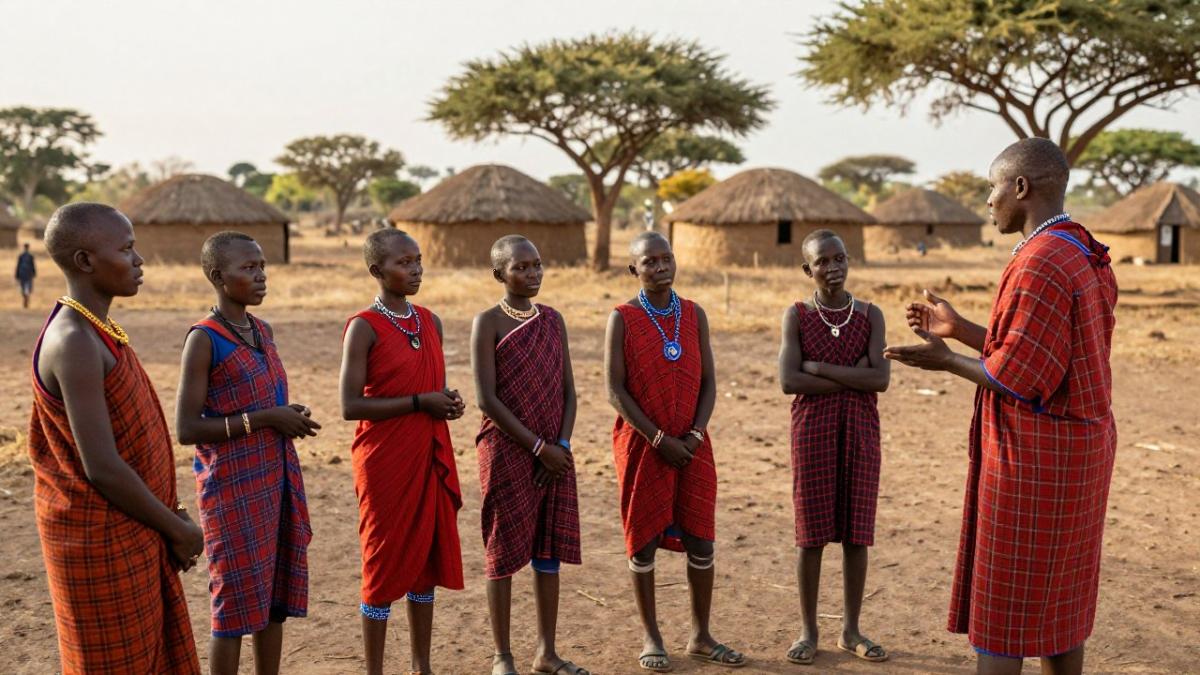
A community visit on safari usually lasts two to four hours: a welcome and introduction, a walk through the homestead or village, a demonstration or craft session, and time for questions. Expect to sit on low stools or mats, accept tea if offered, and move at the host's pace.
What Actually Happens, Hour by Hour
A well-run visit tends to follow a recognizable arc. Knowing it in advance removes the awkwardness of not knowing when to speak, sit, or leave.
- First 15-20 minutes, welcome and framing. A host greets the group, explains what is and is not open to visitors, and introduces the interpreter. Ask about photography, gifts, and off-limits areas here.
- Next 45-60 minutes, walk and demonstration. You move through the homestead, fields, or workshop as hosts show a task in progress, milking, beadwork, coffee processing, carving, rather than a staged performance. Questions are welcome but should follow the host's lead.
- Next 30-45 minutes, conversation and craft. Sit down, ask about the work, the season, the school, the market, and buy directly from makers if you intend to buy at all.
Practical Points Travelers Ask About Most
- Fees: Village entry fees are set by the community and usually paid in cash. Confirm the amount, currency, and recipient with your operator beforehand, and whether the fee is per person, per vehicle, or per group.
- Facilities: Bathrooms may be basic or absent. Carry tissue and hand sanitizer.
- Duration: Shorter visits feel rushed and often read as disrespectful. Two hours is a reasonable minimum; three to four is better if the community is hosting a meal or a longer conversation.
The Host-Side View
Most practitioners find the host's experience of a visit is shaped less by the fee than by how the group behaves. A group that listens, asks before photographing, and buys directly leaves a different impression than one that treats the homestead as a set. To judge whether a visit is well designed, ask your operator how the community was consulted, who leads the visit on the community side, and what happens to the fee after it is collected.
For a fuller picture of what different community programs include, see our cultural immersion experiences.
The Role of Local Guides and Translators
A local guide changes the entire visit. Translators do more than convert words: they explain a joke, flag a topic that is off-limits, and tell you when a host is being polite rather than enthusiastic.
Ask your operator two questions: who leads the community portion, and whether that person is from the community or trained by it. Vague answers are a warning sign. If no interpreter is available, slow down, use names and gestures, and let silence sit rather than filling it, most hosts will meet you halfway.
A well-run community visit follows a predictable arc, and knowing it in advance removes the awkwardness of not knowing when to speak, sit, or leave.
| Stage | Time | What happens |
|---|---|---|
| Welcome and framing | First 15-20 minutes | Host greets group, explains what is open to visitors, introduces interpreter |
| Walk and demonstration | Next 45-60 minutes | Move through homestead, fields, or workshop; hosts show a task in progress |
| Conversation and craft | Next 30-45 minutes | Sit down, ask about work and season, buy directly from makers |
| Closing and payment | Final 15-20 minutes | Community fee settled, thanks exchanged, host explains what money supports |
Photography Ethics in Tribal Communities
Photography guidelines for tribal communities come down to consent, context, and compensation. Ask first, accept no, and never pay a child to pose. If a host agrees to be photographed, show them the image on your screen. It is a small courtesy that builds trust.
African Warrior Maasai Canvas Painting →
A few rules we ask every guest to follow:
- No photographs of ceremonies unless the host explicitly invites them
- No drones over villages or homesteads without community permission
- No photos of people in distress, mourning, or receiving medical care
The camera should never be the reason a conversation ends.
Cultural Safari Cost: Budget vs. Luxury Impact
Cultural safari cost varies widely, and the price difference rarely sits in the village fee itself. It sits in transport, guide quality, group size, and how the operator structures the payment.
What matters more than the tier is where the money lands. Ask your operator directly:
- What share of the cultural fee reaches the community?
- Is payment made to a family, a cooperative, or a village fund?
- Does the community have a say in how funds are used?
A luxury price does not automatically mean a better community outcome. For guidance on choosing operators that route money well, read our article on supporting local communities on safari.
Budget vs. Luxury: Where the Money Actually Goes
A common pattern is that the village fee is the smallest line in the cultural budget. On a typical itinerary, the community payment is a modest per-person amount, while transport, guide time, park fees, and lodging absorb the rest.
- Budget group tours often deliver a high headcount to a village in a short window. The per-visitor fee may be low, the visit brief, and the host's time stretched across a large group. The community may still benefit, but the depth of the encounter is limited.
- Mid-range private itineraries tend to allow a smaller group, a longer stay, and a dedicated interpreter. The community fee is usually higher per visitor, and the host has more time per guest.
- Luxury itineraries can be the best or the worst for impact. The best route a meaningful share of the cultural fee to a community fund and build in repeat visits. The worst treat the village as a scenic add-on and pay a token amount.
The practical test is not the price tag. It is whether the operator can tell you, without hedging, who receives the money, how much of it reaches the community, and what the community decided to do with it.
How to Verify Post-Visit Impact
Most articles stop at the experience. The harder question is whether the operator actually supports the community after the vehicle leaves. A few practical checks separate operators who do from operators who say they do.
- Ask for a named recipient. A family, a cooperative, a school, or a village fund, with a contact or a role, not just a category. "The community" is not an answer.
- Ask what the last payment funded. A specific answer, a water tank, school books, a clinic roof, a craft cooperative's materials, is a good sign. A vague answer is not.
- Ask whether the community can refuse. A genuine partnership allows a village to say no to visits, set limits on photography, and end the arrangement. If the operator cannot describe a case where a community declined, the relationship may be one-sided.
Watch out: an operator who cannot name a single community contact or describe a single funded project is likely selling access, not partnership.
The Anti-Tourist Guide: Spotting a 'Human Zoo'
The most important skill in cultural tourism is recognizing when a visit has become an exhibition. A few signals are reliable.
- Staged arrivals. Dances or demonstrations timed to your vehicle, with no other activity in the village, suggest a performance rather than daily life.
- Children as the main attraction. If the visit centers on photographing children, or children are coached to pose, the encounter is being sold as spectacle.
- No right of refusal. If no one says no to a photograph, a question, or an entry into a home, the hosts may not feel empowered to set boundaries.
A responsible visit is slower, less photogenic, and harder to schedule. That friction is the point. If you want a practical rule: choose the operator who can describe the community's role in designing the visit, not just the itinerary's role in filling an afternoon.
Combining Wildlife Safaris with Cultural Immersion
Wildlife and culture work best when they alternate rather than compete. For a ready-made plan, see this Tanzania cultural tour itinerary for families. A morning game drive followed by an afternoon village visit gives you contrast: the quiet of the bush, then conversation and craft.
A workable rhythm for a short trip:
- Day one: Arrival and a gentle game drive to settle in
- Day two: Early wildlife viewing, then a community visit in the afternoon
- Day three: Full-day game drive or a Kilimanjaro foothills walk
- Day four: Cultural craft session and a market visit
- Day five: Final game drive and departure
Request a Quote for Your Cultural Safari
Planning a trip that treats hosts as hosts, not attractions, takes local knowledge and honest conversations about money and consent. Our team also sources handcrafted pieces, from Mpingo wood Maasai sculptures to the Maasai warrior canvas painting, so what you bring home carries a name and a story.


Tell us your dates and what you want to understand, not just see. Get started with Simcha African Safaris Limited and request a quote for a cultural safari built around respect and real conversation.
Frequently Asked Questions
How can travelers tell whether a cultural safari experience is ethical?
Ask three questions before booking. First, who receives the money: does the community get a direct share, or does it all go to the operator? Second, who sets the terms of the visit: are elders and local leaders involved in planning, or is it staged for cameras? Third, what is the group size and schedule: small groups on community-set timelines signal respect, while large buses on tight clocks usually do not. A responsible operator will answer all three without hesitation.
How much do tribal encounters on African safaris cost?
Cultural safari cost varies with group size, location and whether the visit is a half-day add-on or a multi-day stay. Budget options usually mean larger groups, shorter visits and less direct community payment. Higher-priced itineraries typically include smaller groups, longer time in the village, a translator and a direct community fee. Ask your operator to break down how much of the fee reaches the community, and compare that figure rather than the headline price.
How can you respectfully photograph people during a cultural encounter?
Ask first, every time, and accept a no without negotiating. Point to your camera and wait for a clear yes. Avoid photographing children without a parent or guardian present. Do not pay per photo unless the community has set that rule itself, because cash-for-pictures turns a conversation into a transaction. If you plan to publish images, say so up front and offer to share copies back with the village through your guide.
Can you combine wildlife viewing with cultural experiences on safari?
Yes, and the best itineraries build both into one route. A typical pattern is game drives in the morning, a community visit in the afternoon when animals are less active, then a return to camp for the evening. Keep cultural visits to one or two per trip so neither experience feels rushed. Ask your operator how travel time between parks and villages is handled, since long transfers are the main reason cultural stops get cut short.
What should you expect during a community visit on safari?
Expect a welcome from a host or elder, an introduction to daily life such as farming, herding or craftwork, and time for questions through a translator. Some visits include singing, dancing or a market. Do not expect to see every ceremony: many are private and closed to visitors, and that boundary is part of what keeps the culture intact. Bring modest clothing that covers shoulders and knees, and ask before entering homes or filming.


