

Table of Contents
- Before You Arrive: Choosing a Community-Led Maasai Village Visit
- Maasai Village Visit Dress Code: What to Wear and What to Leave Behind
- How to Greet Maasai Elders and Respect Social Hierarchy
- Photography Rules in Maasai Villages: Consent Comes First
- Gift-Giving, Souvenirs, and Avoiding Dependency
- Understanding the Boma: Sacred Spaces, Taboos, and Daily Life
- Interacting with Children and Avoiding Performative Tourism
- After the Visit: Reflection and Sustainable Souvenir Purchases
- Frequently Asked Questions
Last Updated: October 1, 2026
Before You Arrive: Choosing a Community-Led Maasai Village Visit
Maasai village etiquette in Tanzania starts long before you step out of the safari vehicle. It starts with choosing the right visit. A community-led tour puts money and decisions in the hands of the people who live there.
Ask these questions before you book:
- Who receives the fee, and how much stays in the village?
- Is the visit capped at a small group size?
- Does a local guide lead the tour, not just an outside operator?
Maasai Village Visit Dress Code: What to Wear and What to Leave Behind
The Maasai village visit dress code favors modesty and neutral colors. Cover your shoulders and knees, skip the bright logos, and leave the flashy jewelry at the lodge.
Modesty Standards for Men and Women
For women, a light scarf helps. It covers shoulders and doubles as sun protection. For men, a collared shirt and long trousers work well.
Keep these rules in mind:
- Wear long trousers or a skirt below the knee
- Choose muted colors over neon or camouflage
- Bring closed shoes for uneven ground
- Pack a hat for sun, not for style
How to Greet Maasai Elders and Respect Social Hierarchy
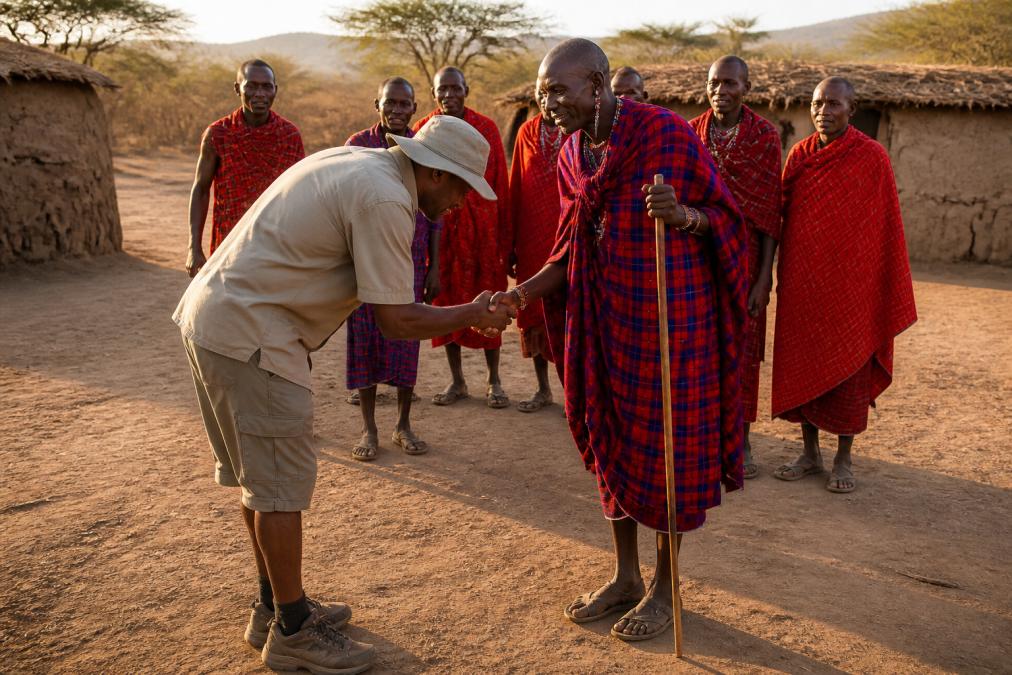
Learn how to greet Maasai elders before you arrive. A calm, respectful greeting opens every door in the village. The Maasai honor age and rank, so who you greet first matters, and so does how you do it.
Reading the Hierarchy Before You Speak
Maasai social order is not a single ladder. It runs on at least three tracks at once: age, gender, and age-set (the olaji, a cohort of men initiated together who move through life stages as a group). A young man who has completed emorata (warrior stage) outranks a boy, but a senior elder, an oloiboni or a respected laigwanan, outranks everyone in the room on matters of custom and blessing.
In practice, this means:
- Greet the eldest man or woman present first, then move down by age.
- If a senior elder is seated, do not tower over them. Crouch or bend slightly to their level.
- Wait to be introduced by your local guide. Do not walk up and initiate with the most senior person unprompted.
- When a group of elders is present, greet the one your guide indicates, then let that elder direct you to the next.
The Mechanics of the Greeting Itself
A Maasai greeting is a sequence, not a single act. Rushing it reads as disrespect.
- Approach slowly and stop at a respectful distance.
- Offer your right hand, never the left, which is reserved for hygiene.
- Support your right forearm with your left hand as you shake. This two-handed grip signals respect, especially with elders.
- Keep your voice low and your gaze soft. Sustained, unbroken eye contact with an elder can read as a challenge.
- Ask "Sopa?" and wait. The reply is usually "Sopa" back, sometimes "Epa" (a response used among peers and elders).
- Let the elder release the hand first.
Basic Maa Phrases That Go a Long Way
A few words of Maa show effort, even if your accent is rough. Pronunciation is approximate, ask your guide to model each one before you use it.
- Sopa, a common greeting, similar to "hello." Used across ages and genders.
- Epa, a response to sopa, often used between peers and elders.
- Ashe (or Ashe oleng), thank you (thank you very much).
- Eserian, peace, often used as a blessing.
- Kai, a casual "hi" or "how are you" among younger speakers.
- Takwenya, a greeting used specifically between women, often paired with a handshake.
- Ipaipa, a greeting exchanged between men, sometimes accompanied by a light touch of the foreheads.
Swahili as a Backup
Maa is the language of the home, but most Maasai adults also speak Swahili, and many speak English. If your Maa runs out, Swahili is a respectful fallback:
- Jambo, hello (formal, widely understood)
- Habari, how are you / what's the news
- Asante, thank you
- Karibu, welcome (often said to you, not by you)
What Not to Do
- Do not greet children before elders. It inverts the order and reads as a small insult.
- Do not use the left hand for anything that touches another person.
- Do not pat an elder on the back or shoulder. Physical familiarity is earned, not assumed.
- Do not ask an elder's age directly. Age is inferred from age-set and life stage, not from a number.
- Do not photograph the greeting without asking first, see the photography section below.
Photography Rules in Maasai Villages: Consent Comes First
Photography rules in Maasai villages come down to one principle: ask first, every time. Consent is not a formality. It is the line between a guest and a trespasser.
A simple approach works best:
- Ask your local guide to request permission
- Wait for a clear yes
- Show the person the photo if they want to see it
- Respect a no without pushing back
Gift-Giving, Souvenirs, and Avoiding Dependency
Gift-giving requires care. Random handouts can create dependency and shift a community's expectations in ways that hurt long-term.
Try these instead:
African Mask. Mask. Mpingo wood. masaai →
- Ask the guide what the village actually needs
- Support the local school or clinic through official channels
- Buy crafts directly from the makers
Understanding the Boma: Sacred Spaces, Taboos, and Daily Life
A boma is a traditional Maasai homestead, a ring of homes and livestock enclosures built around a central cattle kraal. It is a family home, not a set.
Respect these boundaries:
- Do not enter a home without an invitation
- Never step into the cattle kraal unasked
- Treat ceremonial objects as sacred, not props
- Ask before touching anything
Interacting with Children and Avoiding Performative Tourism
Interacting with children needs the same care as any other contact. Ask a parent or guardian first. Then keep it brief and kind.
Signs of a performative visit:
- A fixed "show" with no daily life
- Photos staged for tips only
- No real conversation with residents
After the Visit: Reflection and Sustainable Souvenir Purchases
Post-visit reflection turns a good trip into a lasting one. Most guides stop at the gate. The harder work, and the part that actually respects the community you just visited, happens in the days and weeks after you leave.
A Simple Reflection Framework
Use these four questions within 48 hours of the visit, while details are still sharp. Write the answers down; memory rewrites itself fast.
- What did I learn that I did not expect? Not the choreographed dance, the quiet thing. A child's name. A grandmother's joke. The way the boma smelled at dusk.
- Where did I feel uncomfortable, and why? Discomfort is often the signal that you crossed a line you did not know existed. Name it so you do not repeat it.
- Who benefited from my money, and how do I know? If you cannot answer this, that is information too.
- What will I do differently on the next visit? Concrete, not aspirational. "I will ask the guide before photographing children" beats "I will be more respectful."
The Ethics of Crafts vs. Cash
This is the gap most guides skip. Gifts and purchases are not the same thing, and the difference matters to the village's long-term health.
A practical hierarchy, from most to least respectful:
- Buy directly from the maker, in the village, at a fair price. Ask who carved or beaded the piece. If the seller cannot name the maker, walk away.
- Buy through a cooperative or women's group that pools income and reinvests in the community.
- Give through official channels, a school, clinic, or community fund your guide can name, rather than to individuals.
- Give useful goods only when asked for. A clinic that requests gloves will use them. A school that did not ask for pens has a closet full of them.
- Avoid cash to children. This is the single most common mistake and the hardest to undo.
What to Look For in a Souvenir
A respectful purchase has three traits:
- Traceable, you can name the maker or the workshop.
- Locally made, the materials and labor come from the region, not a factory elsewhere.
- Fairly priced, the price reflects the hours of work, not just the tourist markup. Haggling a beadworker down to half is not a win.
At Simcha African Safaris Limited, our handcrafted art comes with its story. Consider these pieces:
| Item | Material | Price | Meaning |
|---|---|---|---|
| Maasai Mask | Mpingo wood | $130.00 | Maasai heritage |
| Cow Mask | Mpingo wood | $135.00 | Cattle as wealth |
| Elephant Maasai Mask | Mpingo wood | $130.00 | Wildlife as beauty |
| Maasai Man Sculpture | Mpingo wood | $120.00 | Cultural endurance |
Frequently Asked Questions
What should I wear when visiting a traditional Maasai village?
Cover your shoulders and knees, and avoid tight or revealing clothing. Loose, breathable fabrics in neutral colors work best. Women should skip tank tops and short skirts; men should wear collared shirts and long trousers. Remove hats and sunglasses when speaking with elders. Comfortable closed-toe shoes are practical for uneven ground. Your Maasai village visit dress code should show respect for local modesty standards, and modest attire helps you blend in rather than stand out as a tourist.


Is it appropriate to take photographs of Maasai people and their homes?
Only with explicit permission. Photography rules in Maasai villages require asking before every shot, including photos of children, homes, and ceremonies. A simple gesture toward your camera and a questioning look works if language is a barrier. Never photograph sacred objects or ongoing rituals without a clear yes. Some individuals may ask for a small fee, which is their right. Respect a no without negotiation. If you plan to share images publicly, mention that and get consent again.
What is the proper way to greet a Maasai elder?
Approach slowly and wait to be acknowledged. Extend your right hand for a handshake, supporting your right forearm with your left hand as a sign of respect. Lower your gaze slightly and avoid direct, prolonged eye contact. Ask how to greet Maasai elders in the local Maa language beforehand: 'Supai' works as a general hello. Let the elder initiate conversation topics. Avoid interrupting or turning your back on them. A calm, unhurried manner signals that you value their time and status.
How can I ensure my visit supports the local community ethically?
Book through operators that use community-led tourism models, where fees go directly to the village. Buy handicrafts from local artisans rather than mass-produced souvenirs. Ask before giving money or candy to children, as this can create dependency. Instead, contribute to a village fund or school if the community has one. Sustainable souvenir purchasing keeps money in the community and preserves heritage.
Visiting a Maasai village asks more of you than a safari does. It asks for patience, humility, and a willingness to follow someone else's rules for a few hours. Simcha African Safaris Limited builds these visits around community consent, expert local guides, and flexible trips that fit your schedule, from 3 to 7 days. We also connect you with handcrafted mpingo wood art you can trace to its maker. Request a quote and let us plan a Tanzania journey that respects the people who call it home.


