

Quick Summary
Most safari insurance policies cover lost luggage, but payouts depend on the policy's total baggage benefit, per-item limits, and exclusions. Camera gear often has lower caps than expected, so check those limits before you travel.
- Read the baggage benefit section for the total maximum payout and per-item limit.
- Photographic equipment can carry a sublimit far below your total baggage benefit.
- Scheduled endorsements list valuable items with agreed values but need serial numbers and proof of purchase.
- File a carrier report or police report promptly, since insurers often require one.
- Keep receipts for essential purchases, because delay reimbursements usually need itemized proof.
Table of Contents
- What Safari Travel Insurance Covers for Baggage
- Lost, Delayed, Stolen, and Damaged Baggage: How Each Is Treated
- Insuring Camera Equipment and Expensive Gear
- Baggage Delay Benefits and Essential-Item Reimbursement
- Small-Aircraft and Safari-Lodge Baggage Restrictions
- How to File a Baggage Claim, Step by Step
- Booking Your Safari Trip Once Your Coverage Is Confirmed
- Frequently Asked Questions
What Safari Travel Insurance Covers for Baggage
Last Updated: November 5, 2026
Yes, most safari insurance policies cover lost luggage, but the details matter more than the headline. Many travelers assume their gear is protected, only to learn later that a policy caps certain items or excludes them entirely. Knowing what your policy says before you leave is the single best way to avoid a costly surprise.
In general, baggage coverage pays out when your personal belongings are lost, stolen, or damaged during your trip. Some policies also reimburse you when your checked bags are delayed for a set number of hours. Others only cover baggage that is carried by an airline and not items you keep with you on a game drive.
Read the policy's baggage benefit section first. Look for these terms:
- Baggage benefit: The maximum amount the policy will pay for all your bags combined.
- Per-item limit: The most it will pay for any single item, such as a camera.
- Exclusions: Items the policy will not cover, such as cash, passports, or items left unattended.
- Deductible: The amount you pay out of pocket before coverage starts.
Lost, Delayed, Stolen, and Damaged Baggage: How Each Is Treated
Insurers often treat these four situations differently, so it helps to know which one applies to your case. A bag that never arrives is handled differently from one that arrives with a broken zipper.
- Lost baggage: The airline or carrier cannot locate your bag. Most policies pay after the carrier confirms the loss in writing.
- Delayed baggage: Your bag arrives, but later than expected. Many policies pay for essential items you buy while you wait.
- Stolen baggage: A bag is taken by theft. Policies usually require a police report, so file one promptly.
- Damaged baggage: A bag or its contents are broken during transit. You may need a carrier damage report to make a claim.
Unattended baggage is a separate issue. Leaving a bag in a lodge lobby or vehicle can void coverage, even if the bag is later stolen. Keep valuables with you whenever possible.
Insuring Camera Equipment and Expensive Gear
Camera bodies, telephoto lenses, and stabilized binoculars are the items most likely to blow past a standard baggage limit under safari insurance. A single full-frame body with a 100-400mm zoom can easily exceed the total baggage benefit on an entry-level travel policy, so the headline number tells you very little about what you would actually recover.
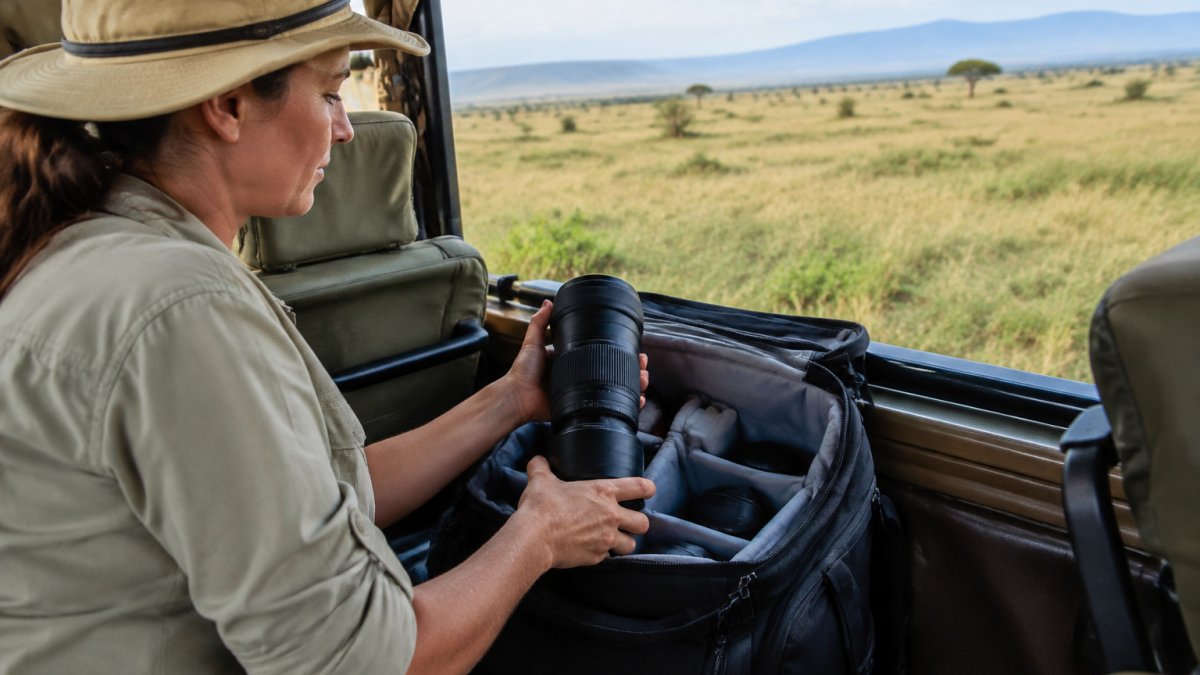
Four mechanisms decide the payout on gear, and they stack on top of each other:
- Per-item limit. The most the policy pays for any one item, regardless of its value. A $6,000 lens under a $500 per-item cap recovers $500 before the deductible.
- Category sublimit. A cap on a class of property, commonly electronics, photographic equipment, or jewelry. It applies even when your total baggage benefit is much higher.
- Settlement basis. Actual cash value pays replacement cost minus depreciation; replacement cost coverage pays what it costs to buy the item again. A three-year-old camera body settled on an actual-cash-value basis may recover well under half of today's retail price.
- Deductible. Subtracted from the covered amount, and some policies apply it per claim rather than per trip.
Scheduled-Item Endorsements
If your kit is worth more than the policy's per-item or category caps, ask the insurer about scheduling specific items. A scheduled endorsement lists individual pieces, body, lenses, binoculars, with agreed values and typically removes or raises the per-item cap and may waive the deductible for those items. The trade-off is that scheduling usually requires serial numbers and proof of ownership at purchase, and it raises the premium. Once your gear is protected, you can also learn practical wildlife photography techniques for game drives.
Do the Math Before You Buy
Add up the replacement cost of everything in your camera bag, then compare that figure against three numbers in the policy: the total baggage benefit, the per-item limit, and the photographic or electronics sublimit. The smallest of those three is your realistic ceiling for a single lost camera. If the ceiling is below the value of your most expensive piece, either schedule that piece or look for a plan with higher gear limits.
Watch out: a policy that advertises a generous total baggage benefit can still cap photographic equipment at a small fraction of that figure, so read the sublimit schedule rather than the summary page.
Documentation That Makes a Gear Claim Payable
Insurers settle gear claims on proof, not on memory. Before departure, photograph each item on a plain surface, record serial numbers, and keep purchase receipts or card statements in a cloud folder separate from the gear itself. A simple inventory sheet listing item, purchase date, purchase price, and serial number shortens the claim review considerably. If you bought the item used or received it as a gift, note the replacement cost you can document rather than an estimated original price.
Gear limits are the part of a safari policy most likely to leave a camera owner short, so the article's key mechanisms are summarised below.
| Mechanism | What it does | Watch for |
|---|---|---|
| Per-item limit | Caps payout for any one item | A $6,000 lens under a $500 cap recovers $500 |
| Category sublimit | Caps a class of property, such as photographic equipment | Can sit far below the total baggage benefit |
| Actual cash value | Pays replacement cost minus depreciation | Older gear may recover under half its retail price |
| Replacement cost | Pays what it costs to buy the item again | Confirm which basis the policy uses |
| Deductible | Subtracted from the covered amount | Some policies apply it per claim, not per trip |
| Scheduled endorsement | Lists items with agreed values | Needs serial numbers and proof of purchase, and raises the premium |
Baggage Delay Benefits and Essential-Item Reimbursement
When your luggage is delayed, you will likely need clothing, toiletries, and other basics. Many policies reimburse these purchases, but usually only after a waiting period, often 6 to 12 hours.
Keep every receipt. Reimbursement claims are often denied when the purchases are not itemized or do not look essential. Buy practical items, such as a change of clothes and a toothbrush, rather than luxury goods.
Small-Aircraft and Safari-Lodge Baggage Restrictions
Many safari itineraries use small bush planes, which have strict weight limits. Airlines often allow only one soft bag of about 15 to 20 kilograms, which is roughly 33 to 44 pounds, plus a small carry-on. Hard-shell cases are frequently refused.
These limits can affect your coverage too. If you are forced to leave a bag behind or ship extra gear separately, your insurer may ask for proof that the items were properly transported. Confirm the luggage rules with your operator before you fly, and keep your gear within the stated limits.
How to File a Baggage Claim, Step by Step
A claim moves faster when the paperwork is assembled in the right order. The sequence below reflects the pattern most insurers and carriers follow; confirm the specific deadlines in your policy, because they vary and missing one is the most common reason a valid claim is denied.
- Report the loss immediately, to the right party. For an airline loss or delay, file at the carrier's baggage service desk before leaving the airport. For theft, file a police report in the jurisdiction where it happened. For a loss at a lodge or in a vehicle, notify management in writing the same day.
- Get the carrier's written report. Ask for a Property Irregularity Report (PIR) for airline baggage. This document number is what your insurer will use to confirm the loss occurred in transit. Keep the original and a photo of it.
- Preserve proof of travel and ownership. Keep boarding passes, baggage tags, the itinerary, receipts, serial numbers, and pre-trip photos of the gear. If you filed a police report, keep the report number and a copy.
- Notify your insurer within the policy window. Many policies require notice within a set number of days of the loss, often 24 to 72 hours for theft and a longer window for other losses. Call or submit the online notice even if you do not yet have every document.
- Complete the proof-of-loss form. This is where the payout is decided. List each item with purchase date, purchase price, serial number, and replacement cost. Attach receipts and photos. For high-value gear, expect the adjuster to apply depreciation if the policy settles on actual cash value.
- Pursue the carrier's liability first where required. Airlines are liable for checked baggage under their tariffs and, for international itineraries, under the Montreal Convention, which sets a per-passenger liability limit. Many travel policies are excess or secondary to that recovery, meaning the insurer pays the gap after the airline's payment. Submit the carrier claim and keep the carrier's response, the insurer will ask for it.
- Track the claim and respond to requests quickly. Keep copies of every email and form. If the adjuster requests additional documentation, supply it within the stated window; unanswered requests are a common cause of stalled claims.
A Practical Claim Checklist
Use this list as you go, and keep it in the same folder as your policy:
- Policy number, insurer claims phone number, and the policy's notice deadline
- Carrier PIR number or police report number
- Boarding passes, baggage tags, and itinerary
- Itemized list of lost gear with serial numbers and purchase dates
- Receipts or card statements for each item
- Pre-trip photos of the gear and of the packed bag
- Copies of all correspondence with the carrier and the insurer
Watch out: accepting a quick cash settlement from an airline before your insurer has reviewed the claim can reduce or complicate your insurance recovery, because many policies credit the carrier's payment against the loss. Confirm with your insurer how a carrier settlement will be treated before you sign a release.
Booking Your Safari Trip Once Your Coverage Is Confirmed
Once you know what your policy covers, you can plan the trip with confidence. Simcha African Safaris Limited offers curated Tanzania safari experiences, from Big Five game drives to combination trips that include whale shark adventures. Before you commit, review park entry fees and permit booking so you know what the trip will cost. Safari durations range from 3 to 7 days, so you can choose the length that suits your schedule.
Request a quote through the Simcha African Safaris Limited website to discuss an itinerary tailored to your plans. Before you book, review your insurance and confirm your gear fits within any limits. A little preparation now helps you focus on the wildlife once you arrive.
Frequently Asked Questions
Is safari covered in travel insurance?
Most standard travel insurance policies cover the trip itself, including medical emergencies and trip cancellation, but coverage for the safari activities depends on the policy. Many plans exclude high-risk adventure activities unless you buy an add-on or a specialized adventure policy. Read the activity exclusions carefully before you buy, and confirm in writing that game drives and any aircraft transfers are included. Travelers booking through a safari operator should ask whether a policy is bundled or whether they must purchase one separately.
Are lost items covered under travel insurance?
Lost items are often covered under the baggage or personal effects section of a travel insurance policy, but usually only up to a set limit. Policies typically require proof that the items were in your possession and that you took reasonable care of them. Items left unattended, such as a bag left in a lodge lobby, may be excluded. Keep receipts and photos of valuables before the trip so you can support a claim if something goes missing.
Does travel insurance cover stolen camera gear on safari?
Stolen camera gear may be covered, but many policies cap electronics and camera equipment with per-item or category sublimits well below the replacement value of professional kits. A policy with a $1,500 total baggage limit and a $500 electronics sublimit, for example, would not fully replace a $4,000 camera setup. Check whether your gear must be carried on your person or can be checked, and whether theft from an unattended vehicle is excluded. Adding a rider or scheduling high-value items on the policy can close the gap.


