

Table of Contents
- Why Ethical Safari Practices Matter More Than Ever in 2026
- 1. How to Choose an Ethical Safari Operator
- 2. Wildlife Viewing Etiquette in National Parks
- 3. Supporting Local Communities on Safari
- 4. Eco-Friendly Camp Practices: Waste, Water, and Energy
- 5. Calculating Your Safari's Carbon Footprint
- 6. Post-Safari Impact Reporting and Technology's Role in Ethical Monitoring
- Conclusion: Turning Ethical Intent into Action
- Frequently Asked Questions
Last Updated: September 18, 2026
Why Ethical Safari Practices Matter More Than Ever in 2026
An ethical safari is a wildlife journey built on three commitments: protecting animals and habitats, respecting local communities, and reducing your own environmental impact. It is not a marketing label. It is a set of choices you make before you book, while you travel, and after you go home.
1. How to Choose an Ethical Safari Operator
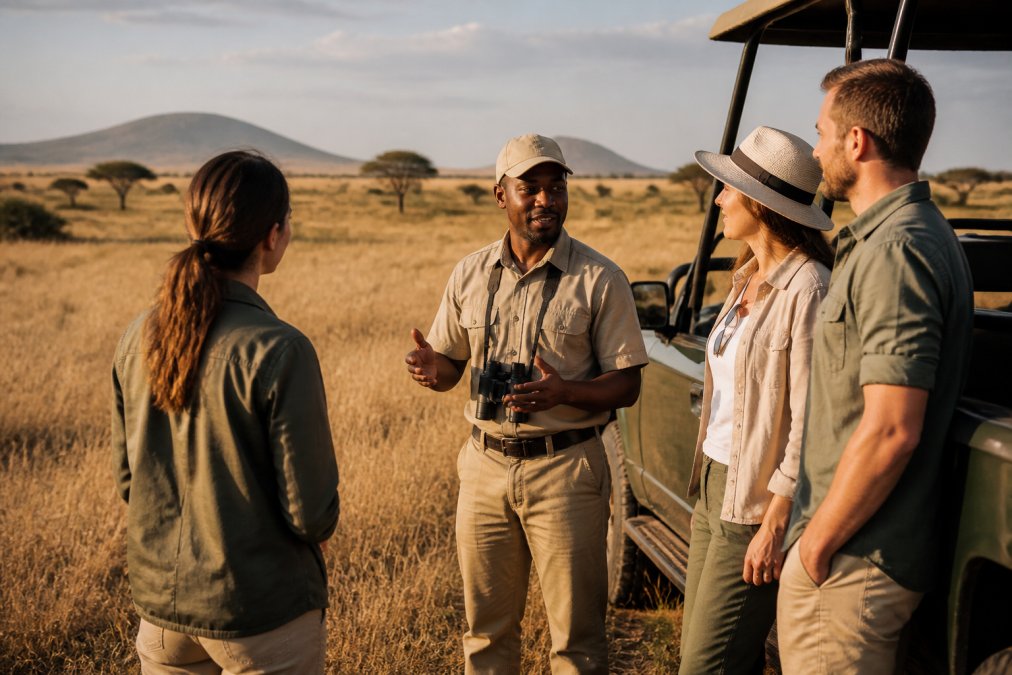
Start with the operator, because almost every other ethical decision flows from theirs. A responsible operator hires local guides, pays conservation fees, follows park rules without being asked, and can explain where your money goes.
Greenwashing Red Flags to Watch For
Greenwashing in safari marketing usually hides in adjectives. Watch for operators who use "eco" and "sustainable" heavily but publish nothing specific. Three reliable red flags:
- No named conservation partner, just "we support conservation"
- No mention of park fees, community levies, or where revenue lands
- Photos of off-road driving, close-up wildlife with no distance, or guests touching animals
2. Wildlife Viewing Etiquette in National Parks
Wildlife viewing etiquette in national parks comes down to one principle: the animal sets the distance. Your guide should keep vehicles on designated tracks, cut engines when animals are close, and never crowd a sighting.
Photography Ethics: Flash, Distance, and Patience
Wildlife photography ethics start with restraint. Never use flash on nocturnal animals, never use playback calls to lure birds, and never ask a guide to move closer for a better frame.
3. Supporting Local Communities on Safari
Community-based tourism works when money stays local, but "local" is a claim you can test. The difference between a camp that genuinely uplifts its neighbors and one that uses the word "community" as decoration shows up in hiring, sourcing, and where the conservation fee actually lands.
- Employment: What share of guides, trackers, cooks, and camp staff come from within roughly 30 miles of the property? A common pattern among operators with real community ties is 60-80% local hires, with training programs for trackers and spotters who started as porters.
- Sourcing: Does the kitchen buy produce, eggs, and meat from nearby farms and cooperatives, or does everything arrive on a supply truck from a distant city? Local procurement keeps more of your nightly rate circulating in the region.
- Revenue flow: Ask what percentage of your trip cost goes to park fees, community levies, and conservancy leases, and who receives it. In community-run conservancies, lease payments to landowners are often the single largest household income source, which is why they matter more than a one-time donation.
- Governance: Is there a community liaison or a joint committee that decides how tourism revenue is spent? Projects chosen by outside operators (a new signboard, a painted school wall) tend to matter less than projects chosen by residents (water access, scholarships, clinic staffing).
Cultural Sensitivity: Beyond the Photo Rule
Cultural sensitivity is not just "ask before photographing people." It is about consent, context, and compensation:
- Ask before photographing, and accept no as a complete answer, not a negotiation.
- Do not photograph children without a parent or guardian's permission.
- If you visit a village, ask whether the visit was arranged through a community representative or simply routed through a camp's front desk. The former usually means the community set the terms; the latter often means the camp did.
- Pay for performances, crafts, and guided walks at rates the makers set, not rates you negotiate down. Haggling hard on a $20 carving is not cultural exchange.
Buying Authentic Handcrafted Art and Masks
Buying directly from makers keeps more money in the community and gets you something real. Look for pieces with visible hand-work, natural variation, and a maker who can tell you about the material.
4. Eco-Friendly Camp Practices: Waste, Water, and Energy
Eco-lodges differ from ordinary camps in measurable ways: solar power, water recycling, and waste that leaves the property rather than the park.
5. Calculating Your Safari's Carbon Footprint
Safari travel has a carbon footprint, and pretending otherwise helps no one. The largest share usually comes from international flights, followed by internal flights and vehicle miles.
Elephant Masaai mask. African Mask. →
6. Post-Safari Impact Reporting and Technology's Role in Ethical Monitoring
Most ethical safari guides stop at the moment you leave the park. That is where the real test begins. If your trip was supposed to fund conservation and community projects, you should be able to verify, after the fact, that it did. Few operators volunteer this, and few travelers ask. This section gives you the audit framework to do both.
What a Real Post-Trip Impact Report Contains
Ask your operator, before you book, what you will receive after your trip. A credible report typically includes:
- Park and conservancy fee totals paid on your behalf, itemized by park or conservancy.
- Community levy amounts and the name of the receiving body (a conservancy trust, a village council, a registered foundation).
- Project line items, not just "we support schools," but which school, what was funded (books, teacher stipends, water tanks), and in what amount.
- Wildlife monitoring data your guide contributed, such as sighting logs shared with park authorities or research partners.
How to Audit an Operator's 'Eco' Claims Before You Book
Greenwashing in safari marketing rarely announces itself. It hides in adjectives. Use this four-step audit:
- Ask for the conservation partner's legal name. "We support conservation" is not a partner. A registered trust, a named conservancy, or a park authority is. Search the name independently.
- Ask for a sample impact report from a previous season. Redact guest names if needed, the numbers should still be there.
- Ask which certifications or memberships the operator holds and verify them at the source. Common ones in the region include tourism association memberships and conservation-body affiliations; the point is not the logo, it is whether the issuing body confirms the operator is in good standing.
- Cross-check the itinerary against the claims. If the operator advertises community visits but the itinerary shows no time allocated for them, the claim is decorative.
Technology's Role in Ethical Monitoring
Technology has changed what ethical monitoring looks like on the ground, and it has changed what you can ask about:
- GPS vehicle tracking discourages off-road driving because every deviation from designated tracks is logged. Some park authorities now review this data.
- Camera traps and acoustic sensors monitor wildlife corridors without human presence, reducing the disturbance that comes with repeated vehicle visits.
- Anti-poaching analytics let park authorities spot patterns, snare locations, entry routes, timing, that individual rangers would miss.
- Sighting-data sharing means guides who log sightings contribute to research on ecosystem health over time, rather than treating each game drive as an isolated event.
Conclusion: Turning Ethical Intent into Action
The hardest part of responsible travel is not knowing what to do. It is doing it when a better photo, a closer look, or a cheaper package is right there. The ten practices above give you a way to decide before you are standing in the savanna.
Frequently Asked Questions
What defines an ethical safari operator in Tanzania?
An ethical operator in Tanzania holds current licensing, employs local guides, follows park rules like staying on designated roads, and contributes to conservation through fees or community projects. Ask for specific examples of community partnerships and wildlife protection efforts, not just vague green claims. A trustworthy operator will welcome detailed questions and provide evidence of their practices.
How can tourists minimize their environmental impact during a safari?
Travelers can reduce impact by packing plastic-free, using water sparingly at eco-lodges, avoiding single-use items, and staying on marked trails. Choose camps that manage waste and energy responsibly. Off-road driving is discouraged in national parks because it damages vegetation and disturbs wildlife. Simple choices like reusing towels and refusing plastic bags make a measurable difference over a multi-day safari.
What are the best practices for interacting with local communities on safari?
Ask before photographing people, buy directly from artisans, and treat cultural visits as exchanges rather than spectacles. Supporting local communities on safari means paying fair prices for handcrafted items and respecting traditions. Learning a few Swahili greetings shows respect. When you purchase authentic art, you contribute to local livelihoods and help preserve cultural heritage.
Why is off-road driving discouraged in national parks?
Off-road driving is discouraged because it crushes vegetation, disrupts wildlife corridors, and can cause animals to flee or alter natural behavior. Park regulations in Tanzania prohibit driving off designated tracks. Staying on roads protects habitat preservation and ensures a safer, more authentic wildlife viewing experience for everyone. Ethical operators will never chase animals or leave the track.
How do I ensure my safari supports wildlife conservation efforts?
Choose operators who transparently allocate a portion of revenue to conservation fees, anti-poaching patrols, or habitat restoration. Ask how they contribute to wildlife protection and whether they partner with local conservation groups. Booking with a responsible operator that prioritizes biodiversity and ecosystem health ensures your trip directly supports long-term conservation rather than just profit.


