

Table of Contents
- Understanding Authenticity in Traditional African Art
- How to Spot Fake African Masks and Common Indicators of Modern Reproduction
- Signs of Age in African Wood Carvings: What Natural Wear Looks Like
- Examining Material Composition and Craftsmanship
- African Art Provenance Documentation and Its Role in Valuation
- Understanding Tribal Styles and Ethnic Origins
- Legal and Ethical Sourcing: What You Need to Know
- Conclusion
Last Updated: August 19, 2026
Understanding Authenticity in Traditional African Art
Authenticity in African art means pieces created using traditional methods, materials, and cultural context by artisans from the relevant ethnic group, rather than mass-produced or artificially aged in factories. At Simcha African Safaris Limited, we help travelers and collectors understand this distinction because it directly impacts both cultural value and investment potential.
The global market for African art has exploded, and so has production of convincing fakes. What separates an authentic tribal mask from a marketplace replica comes down to tool marks, material composition, patina development, and provenance documentation.
Authenticity matters for three reasons: authentic pieces carry genuine cultural heritage representing specific ethnic groups' artistic traditions; they hold value and appreciate over time while reproductions depreciate immediately; and acquiring authentic work directly supports artisan communities when sourced ethically. African art wasn't created for export markets, masks served ceremonial functions, sculptures held spiritual significance, and each piece reflected specific community beliefs and practices. Understanding this context helps you recognize when something has been stripped of meaning and retrofitted for Western aesthetics.
How to Spot Fake African Masks and Common Indicators of Modern Reproduction
Fake African masks share predictable characteristics that distinguish them from authentic ceremonial pieces. The most obvious tells involve uniformity, excessive smoothness, and absence of irregularities that define hand-carved work.
Examine surface texture. Authentic masks show evidence of hand-carving, slight asymmetries, tool marks from chisels or knives, and variations in depth reflecting the carver's individual technique. Modern reproductions feature suspiciously uniform surfaces, as if sanded by machine. Run your fingers across the piece (if permitted), real carved masks have subtle ridges, inconsistent finish, and areas where the tool bit deeper or shallower depending on wood density and grain direction.
Look at geometric shapes. Authentic tribal masks incorporate specific patterns tied to ethnic identity, elongated faces among certain groups, particular eye shapes, distinctive nose treatments. Fakes often blend styles indiscriminately, combining elements from multiple traditions in ways no actual artisan would. If proportions feel "off" or stylistic references seem confused, that's a red flag.

Paint and surface patina reveal much. Authentic masks used in ritual contexts show uneven aging, areas of heavier wear where hands frequently gripped the piece, fading in patterns following actual use rather than artificial distressing. Fake patina looks applied, often uniformly darkened or artificially cracked in geometric patterns. Real age develops organically, with some areas shiny from handling and others dull from dust and environmental exposure.
Weight and balance matter too. Ceremonial masks were worn, so they're balanced for that purpose, slightly heavier at the top to sit properly on the head. Reproductions made for display often feel off-balance or too heavy overall because the maker didn't account for functional requirements.
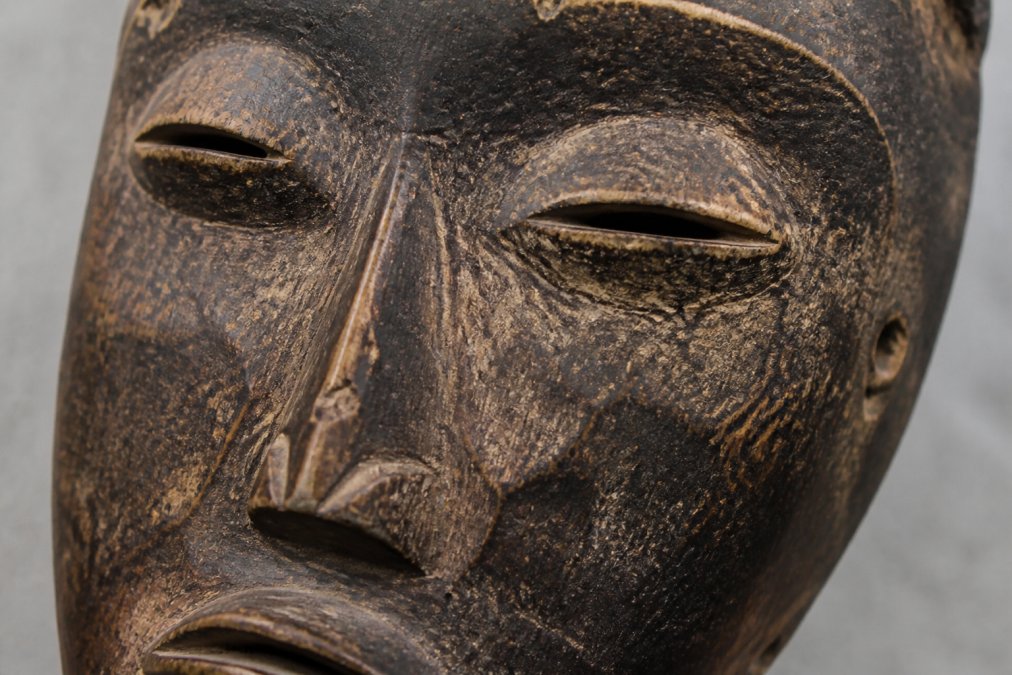
Check for inconsistent aging across the piece. If the face looks ancient but the back is pristine, something's wrong. Real pieces age throughout, front, back, sides, crevices. Fakes often receive artificial aging on visible surfaces only.
Examine the wood itself. Authentic pieces use woods available in the region where they were made, mpingo wood in Tanzania, specific hardwoods in West Africa. If the wood doesn't match the claimed origin, that's a major problem.
Signs of Age in African Wood Carvings: What Natural Wear Looks Like
Natural aging in wood carvings develops in specific, predictable ways that artificial distressing cannot convincingly replicate. Understanding these patterns helps you distinguish genuinely old pieces from those artificially aged to appear ancient.
Authentic age shows through surface oxidation, wood darkens gradually as oils oxidize and dust accumulates in microscopic crevices. This darkening is never uniform. High-contact areas develop different patina than protected surfaces. The underside of a mask that hung in darkness shows different aging than the front facing light and air. This randomness is the signature of real time passing.
Tool marks become less visible over decades but don't disappear. Instead, they develop subtle shine from handling and dust accumulation in carved grooves. A mask carved 100 years ago shows tool marks still visible but softened, sharp edges worn smooth from handling but the basic pattern remaining. Fakes often sand away tool marks entirely or artificially recreate them in ways that look too regular.
Cracks and checks in wood follow grain direction and develop slowly. Pieces exposed to temperature and humidity fluctuations over decades develop radial cracks following the wood's grain structure. These cracks are organic and follow predictable patterns based on wood species. Artificial aging produces cracks that look forced or random, not following natural grain patterns.
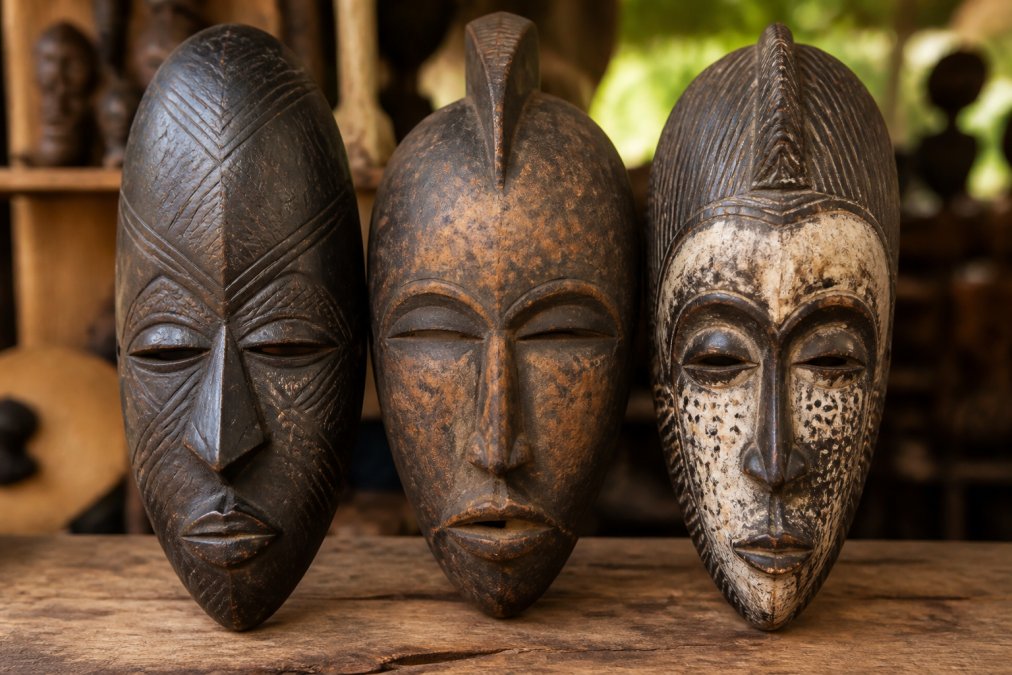
Wear patterns follow function. Masks used ceremonially show heavier wear on the inside where the wearer's face contacted the wood and on edges where hands gripped it. Purely decorative reproductions show random wear or uniform aging, not wear corresponding to actual use.
Color variation within the wood itself provides clues. Real wood darkens unevenly, some areas nearly black while others remain lighter, depending on wood density, exposure, and storage. Artificial aging attempts uniform color, which looks wrong to trained eyes.
Examining Material Composition and Craftsmanship
Materials used in authentic African art directly reflect what was available and valued in each region and time period. Examining these materials reveals whether a piece is genuine.
Mpingo wood, also called African blackwood, was traditionally used in Tanzania and East Africa for masks and ceremonial objects. It's dense, durable, and darkens beautifully with age. If examining a mask claimed to be from Tanzania, mpingo is reasonable. If supposedly from West Africa but made of mpingo, that's a mismatch worth investigating.

Bronze casting for African sculpture requires specific techniques passed down through generations. Authentic Benin bronzes show evidence of the lost-wax casting process, specific texture patterns, air bubbles in consistent locations, and weight distribution reflecting how the piece was cast. Modern bronze reproductions often use sand casting or shortcuts producing different surface characteristics and weight.
Ivory appears in some authentic African art, particularly in West African traditions. However, the Convention on International Trade in Endangered Species (CITES) CITES regulations on ivory trade strictly controls ivory trading. Any ivory piece requires documentation proving it predates the 1989 CITES ban on international ivory trade. Pieces without this documentation are illegal to import into the United States. If a seller claims authenticity but can't provide CITES documentation for ivory pieces, walk away, it's either illegal or fake.
Stone carvings should show evidence of hand-tooling appropriate to the stone type. Soft soapstone carves differently than hard granite, and tool marks reflect this. Authentic pieces show marks consistent with traditional stone-working techniques.
Craftsmanship reveals itself through proportion, balance, and the relationship between form and function. Authentic masks are carved with specific anatomical proportions tied to their cultural meaning. Real craftsmanship shows restraint and adherence to traditional rules, not novelty or exaggeration.
Hand-carved pieces show evidence of the carver's individual technique, a particular way of handling the chisel, consistent patterns in how deep they cut, characteristic ways of finishing edges. Authentic work shows stylistic consistency. Fakes often show inconsistent technique, as if different people worked on different sections.
African Art Provenance Documentation and Its Role in Valuation
Provenance, the documented history of ownership and location, is the single most important factor in valuing authentic African art. A piece with clear provenance can be worth ten times more than an identical piece without it.
Authentic provenance includes documentation showing where the piece came from, who owned it, when it was acquired, and how it moved through the market. Ideal documentation includes photographs from earlier sales, exhibition catalogs, museum records, or letters from previous owners.
Red flags include sudden appearance in the market with no history, claims of "discovered in an estate" with no supporting documentation, or vague origins like "acquired from a dealer." Legitimate pieces usually have some documented history. Fakes often appear with minimal backstory because fabricating detailed provenance is risky.
Museum deaccessioning records provide strong provenance. If a piece was legitimately deaccessioned from a museum collection, that institution's documentation confirms authenticity and provides detailed information about the object.
Gallery and auction house records offer provenance support. Reputable dealers and auction houses maintain records of pieces they've sold. Tracing a piece through multiple legitimate sales strengthens its provenance chain.
Documentation should include photographs from multiple angles, detailed descriptions of materials and condition, and information about the carver or ethnic group if known. The more specific the documentation, the more valuable the piece.
For pieces acquired directly from artisans in Tanzania or other regions, Simcha African Safaris Limited sources handcrafted traditional masks with clear information about the maker, the tribal tradition, and the materials used. This direct sourcing provides the strongest possible provenance for contemporary pieces created using traditional methods.
Understanding Tribal Styles and Ethnic Origins
Each African ethnic group developed distinctive artistic traditions with specific geometric shapes, proportional rules, material preferences, and symbolic meanings. Understanding these traditions helps you recognize authentic work and spot fakes that blend styles inappropriately.
Maasai masks feature elongated faces, geometric patterns of lines and circles, and specific eye treatments. A piece claiming to be Maasai but showing rounded, realistic proportions isn't authentic.
Hehe tribe masks, used in celebrational dances to usher in the birth of newborns, show specific stylistic elements tied to that ceremonial purpose. The proportions, eye carving, and overall composition reflect the mask's intended function.
Chagga tribe masks, particularly those signifying power and worn only by chiefs and dignitaries, feature specific design elements communicating status and authority. Authentic pieces show this intentionality; reproductions often miss the cultural context entirely.

Wahaya tribe masks used in male circumcision celebrations carry specific meanings tied to that rite of passage. The design elements, how the mask sits on the face, and symbolic patterns all relate to the ceremony's significance.
Ethnic origins matter because they determine appropriate materials, stylistic elements, and symbolic meanings. A mask claiming West African origin but made with East African materials and techniques is either misidentified or fake. Authentic pieces show consistency between claimed origin, materials, techniques, and stylistic elements.
Legal and Ethical Sourcing: What You Need to Know
Acquiring authentic African art responsibly requires understanding the legal frameworks governing cultural heritage and endangered materials. This protects both you and the artisan communities whose work you're acquiring.
CITES regulations Convention on International Trade in Endangered Species control trade in pieces containing materials from protected species. Ivory, certain hardwoods, and other materials require specific documentation for legal import into the United States. Any piece containing these materials must include CITES documentation proving either that it predates the relevant ban or that it was legally harvested and traded. Without this documentation, importing the piece is illegal, and you risk confiscation and penalties.
The Nagoya Protocol addresses access to genetic resources and traditional knowledge. While primarily focused on biological resources, it has implications for traditional African art because it recognizes indigenous communities' rights to their cultural heritage, supporting ethical sourcing practices that compensate artisan communities fairly.
U.S. cultural property import laws U.S. Import Restrictions on Cultural Property restrict importation of artifacts from countries that have requested protection for their cultural heritage. Many African nations have requested such protection. Before importing any piece, verify that it doesn't violate these restrictions.
Ethical sourcing means acquiring pieces directly from artisans or through dealers working directly with artisan communities, ensuring money goes to makers rather than exploitative middlemen. When you purchase from Simcha African Safaris Limited, you're supporting artisans who create these pieces using traditional methods. The masks available, including the African Tribal Maasai Traditional Mask in mpingo wood ($130.99), the African Mpingo Wood Heritage Mask used by the Wahaya tribe ($120.99), the Hehe tribe mask for celebrational dances ($145.99), and the Chagga Traditional Mask signifying power ($120.99), are sourced with direct knowledge of the makers and materials.
Avoid pieces with unclear origins or documentation suggesting questionable acquisition channels. If a dealer can't explain where a piece came from, who made it, or provide supporting documentation, the piece is either stolen, illegally exported, or fake.
The legal and ethical framework exists to protect both cultural heritage and artisan communities. Following it ensures your acquisition supports authentic traditions rather than exploitative reproduction and illegal trade.
Identifying authentic African art requires attention to material details, understanding of cultural traditions, and commitment to ethical sourcing. The pieces you acquire should connect you to genuine African heritage, support artisan communities, and hold their value as investments in cultural significance. Simcha African Safaris Limited helps you acquire handcrafted traditional masks and art pieces sourced with knowledge of their makers and cultural context, ensuring that what you bring home carries authentic meaning and supports the communities that created these traditions. Learn more about ethical cultural tourism and authentic sourcing to deepen your understanding of how to engage responsibly with African cultural heritage.
Frequently Asked Questions
What are the main signs that African art is a reproduction rather than authentic?
Reproductions typically show uniform, artificial aging applied evenly across the surface, whereas authentic pieces display organic wear patterns. Look for unnatural patina that appears painted on, perfectly symmetrical tool marks (handcrafted work varies naturally), and modern synthetic materials. Authentic African art shows age-related wear concentrated on high-contact areas. Reproductions often have sharp edges and lack the subtle surface irregularities that develop over decades of use or display.
How important is provenance documentation when buying African art?
Provenance documentation is critical for valuation and authenticity verification. It establishes the piece's history, previous ownership, and cultural context. Reputable sellers provide documentation detailing the tribal origin, creation period, and acquisition source. Without provenance, you cannot verify whether a piece is genuinely handcrafted by traditional artisans or a modern marketplace replica. Strong provenance significantly increases both the collectible value and your confidence in authenticity.
Can I identify authentic African masks by looking at tool marks?
Yes. Authentic hand-carved masks show irregular, varied tool marks that reflect the artisan's individual technique and the natural resistance of the wood. Each stroke differs slightly in depth and angle. Reproductions typically display uniform, repetitive marks created by machine tools or careless hand replication. Examine the interior surfaces closely, authentic pieces show consistent handwork throughout, while fakes often have machine-finished interiors. Tool mark analysis is one of the most reliable ways to distinguish ritual use pieces from marketplace replicas.
What wood types are commonly used in authentic African art, and how can I tell them apart?
Mpingo wood, ebony, and hardwoods native to African regions are traditional choices for masks and carvings. Mpingo, used by Tanzanian tribes including the Wahaya and Chagga, is dense, dark, and highly durable. Authentic pieces feel substantial and show wood density appropriate to their size. Reproductions often use lighter softwoods or composite materials that feel hollow or too light. Examine the grain pattern and color consistency, authentic wood develops natural darkening and patina over time, while treated or stained reproductions show uniform coloring.
This article was written using GrandRanker


