

Table of Contents
- What You Need Before Your First Game Drive
- Best Lens for Tanzania Safari: Focal Length Decisions That Matter
- Safari Camera Settings for Sharp, Consistent Wildlife Shots
- Lighting, Golden Hour, and the Best Times of Day in Tanzania
- Composition Tips for Wildlife Photography on Safari
- Tanzania Park Nuances Every Photographer Should Know
- African Safari Photography Tips for Beginners: Mistakes to Avoid
- Bringing Tanzania Safari Photography Tips Home: Art and Memory
Tanzania Wildlife Safari Photography Tips: A Complete Guide
Last Updated: August 2, 2026
Getting your Tanzania wildlife safari photography right before your first game drive is the difference between blurry, overexposed disappointments and images that genuinely stop people mid-scroll. At Simcha African Safaris Limited, we guide photographers of every skill level through Tanzania's most iconic parks, and we see the same avoidable mistakes repeated constantly. Below, we'll walk you through exactly how to prepare your gear, dial in your camera settings, read the light, and compose shots that do justice to one of the planet's most extraordinary wildlife environments.
Tanzania's specific conditions, the dust of the Serengeti, the dense canopy of Mahale, the vast open plains of the Ngorongoro Crater, each demand a different technical approach.
What You Need Before Your First Game Drive
Preparation is the unglamorous half of safari photography, but arriving underprepared in the Serengeti means missing shots you will never get back.

Essential Camera Gear and Lenses
A mirrorless camera body with reliable autofocus tracking is the current standard for safari photography. Full-frame sensors handle the dynamic range demands of African light better than crop sensors, though a crop sensor with a quality telephoto lens works for beginners.
The minimum useful focal length for wildlife is 300mm. Most experienced photographers carry a 100-400mm zoom lens as their primary tool because it covers medium-distance herd shots to tight portraits without requiring lens changes in a dusty vehicle. A 500mm or 600mm prime produces sharper results at maximum focal length but trades flexibility for reach.
Essential kit:
- Primary body: mirrorless full-frame with weather sealing
- Primary lens: 100-400mm or 150-600mm zoom with image stabilization
- Secondary lens: 70-200mm f/2.8 for lower light and habitat context
- Lens cloths and blower brush
- Hard-sided waterproof camera bag
Memory Card Redundancy, Battery Management, and Weather Sealing
Carry at least four high-speed cards and rotate them daily, never filling a single card completely. According to Wildlife Photography guidelines from the Royal Photographic Society, shooting in raw format produces files between 25 and 50 megabytes each, meaning a morning game drive in burst mode can consume 60 to 80 gigabytes.
Carry three fully charged batteries per body and charge every night. Cold highland mornings drain batteries faster than manufacturer ratings suggest. Weather sealing on both body and lens matters more than photographers expect. A body rated to at least IPX4 will survive a brief downpour.
Best Lens for Tanzania Safari: Focal Length Decisions That Matter
The answer depends on which parks you're visiting and how close animals typically come to vehicles. In the Serengeti, distances are often long and 400mm to 600mm is genuinely useful. In Tarangire, where elephants frequently approach within 10 metres, a 400mm lens is unusable. A 100-400mm zoom handles roughly 85% of Tanzania safari scenarios.
If your budget allows one additional lens, a 500mm f/5.6 prime produces noticeably sharper images of distant subjects. A teleconverter extending your zoom to 560mm or 600mm is a cost-effective alternative, though autofocus speed drops with most combinations.
| Lens Type | Focal Range | Best Tanzania Use Case | Trade-off |
|---|---|---|---|
| 100-400mm zoom | 100-400mm | Serengeti, Ngorongoro general use | Versatile but limited at maximum range |
| 150-600mm zoom | 150-600mm | Distant Serengeti subjects | Heavier, slower autofocus |
| 500mm prime | 500mm | Sharp portraits of stationary subjects | No flexibility in framing |
| 70-200mm zoom | 70-200mm | Habitat shots, close encounters | Insufficient for distant wildlife |
| 24-70mm zoom | 24-70mm | Landscapes, vehicle interiors | Not suitable for wildlife |
Safari Camera Settings for Sharp, Consistent Wildlife Shots
Camera settings are where most beginners lose shots they should have made. Tanzania's light changes fast, and a camera left on wrong settings will fail at the critical moment.
Aperture Priority, Shutter Speed, and ISO Sensitivity
Aperture priority works for stationary subjects in predictable light. Set your f-stop to f/5.6 or f/6.3 for a telephoto zoom and let the camera manage shutter speed.
For moving animals, switch to manual mode or shutter priority and set a minimum shutter speed of 1/1000s for running animals, 1/800s for walking subjects, and 1/2000s or faster for birds in flight. ISO should be set to auto with a ceiling of ISO 6400 on modern full-frame mirrorless bodies. Exposure compensation of -0.3 to -0.7 stops is often necessary in bright African sun to prevent blown highlights on light-coloured animals.
Autofocus Tracking, Burst Mode, and Back-Button Focus
Subject recognition modes that lock onto animal eyes and maintain tracking through grass or branches have transformed keeper rates for action shots. Back-button focus separates focus activation from the shutter button, allowing you to lock focus on a stationary subject and shoot without refocusing.
Lighting, Golden Hour, and the Best Times of Day in Tanzania
Tanzania's equatorial position means the sun rises and sets fast, and light quality changes dramatically within 30 minutes of sunrise and sunset. The golden hour here is genuinely golden: warm, directional, and flattering to every subject.
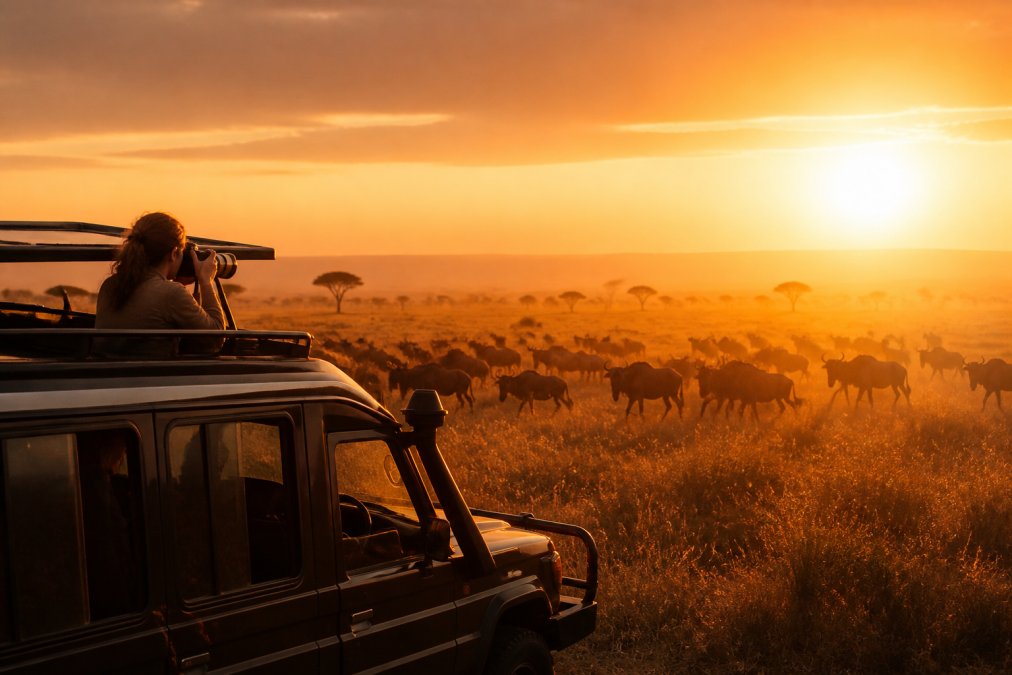
Game drives typically depart at 06:00 to catch first light. The hour between 06:30 and 07:30 produces the most photographically rewarding conditions of the day. Animals are active, light is directional, and colour temperature is warm. The same window applies in the evening from roughly 17:00 to 18:15.

Midday shooting between 10:00 and 15:00 is genuinely difficult. Light is harsh and overhead, producing unflattering shadows and blown highlights. White balance set to "Cloudy" or a manual Kelvin value of 6000-6500K enriches warm tones of golden hour. Auto white balance tends to correct warmth out of the image, producing technically accurate but visually flat results.
According to Tanzania National Parks Authority visitor guidelines, game drives operate within specific hours that align precisely with optimal photography windows.
Composition Tips for Wildlife Photography on Safari
Technical settings get your images sharp. Composition makes them worth looking at. The two most common failures are centring every subject in the frame and ignoring the background entirely.
Eye-Level Perspective, Habitat Inclusion, and Depth of Field
Eye-level perspective transforms wildlife images. A lion photographed from a standing position looks like a zoo shot. The same lion photographed from the lowest possible angle through a side window looks like a wild predator in its environment.
Habitat inclusion separates documentary wildlife photography from trophy shots. Including Serengeti grass, acacia silhouettes, or the volcanic rim of Ngorongoro in your frame tells a story about where the animal lives. Depth of field control using a wide aperture (f/4 to f/5.6) isolates the subject from a busy background, while a narrower aperture (f/8 to f/11) keeps both animal and habitat in focus.
Vehicle Positioning and Using a Beanbag Support
Vehicle positioning determines whether you get a compelling frame or a record shot. Communicate with your driver or guide about positioning before the vehicle stops. Ask for the sun to be behind or to the side of your shooting position, not in front of it.
A beanbag support resting on the vehicle window frame or roof hatch eliminates camera shake at long focal lengths far more effectively than image stabilization alone. Many experienced safari photographers consider a beanbag more important than a monopod in a vehicle context because it conforms to irregular surfaces and absorbs engine vibration.
Tanzania Park Nuances Every Photographer Should Know
Tanzania's parks are not interchangeable, and treating them as a single "safari" environment leads to missed opportunities and wrong gear choices.
The Serengeti is vast and open. Subjects are frequently distant, light is intense, and the Great Migration between July and October delivers the most dramatic wildlife spectacle in Africa. A 400mm to 600mm focal length is essential here.
The Ngorongoro Crater is a self-contained ecosystem with high density of predators and prey in a relatively small area. Animals are often close, and the crater's rim creates extraordinary backlit conditions in late afternoon. A 100-400mm lens is typically sufficient.
Tarangire National Park is underrated by photographers. Ancient baobab trees create compositional anchors unavailable elsewhere in Tanzania, and elephant concentrations during the dry season are among the highest on the continent.
Mahale Mountains National Park, accessible only by boat or small aircraft, offers chimpanzee tracking in dense forest. This environment demands fast lenses (f/2.8 or wider), high ISO capability, and manual focus techniques.
As documented in UNESCO World Heritage Site records for the Serengeti, the Serengeti ecosystem is one of the most biodiverse environments on Earth, a fact that translates directly into the variety of photographic subjects available across different seasons.
African Safari Photography Tips for Beginners: Mistakes to Avoid
The gap between a first-time safari photographer and an experienced one is mostly about avoiding predictable mistakes, not about having better gear.
Ethical Wildlife Photography and Safety Protocols on Safari
Ethical wildlife photography in Tanzania means operating within the rules set by Tanzania National Parks and respecting animal behaviour. Pressuring your guide to approach animals too closely, playing recorded animal calls, or leaving the vehicle in prohibited areas stress animals and alter natural behaviour.
Safety protocols exist because the animals are wild. Stay inside the vehicle unless your guide explicitly confirms it is safe to exit. Keep voices low during sightings. Do not extend arms or camera equipment outside the vehicle in a way that changes the vehicle's silhouette, which predators read as a threat.
Mobile vs. Professional Gear: What Actually Works in the Field
Modern smartphone cameras with 10x optical zoom and computational photography produce genuinely usable images at shorter distances. For close elephant encounters or gorge-level shots, a smartphone with a clip-on telephoto adapter delivers results that would have required professional setup five years ago.
The honest limitation is at distance. For subjects 80 metres or more away, no smartphone currently matches a 400mm or 600mm lens on a mirrorless body. Many Simcha African Safaris Limited guests extend their memory by collecting handcrafted African art alongside their photography. The [Elephant Love oil painting](https://simchasafaris.com/products/elephant-love-oil-painting-had-painting-african-art) and the Leopards in the African Tree canvas painting are hand-painted originals that capture the same subjects you will photograph in the field, bringing a tangible piece of Tanzania's wildlife heritage home.

Bringing Tanzania Safari Photography Tips Home: Art and Memory
Shoot in raw format exclusively. JPEG in-camera processing discards dynamic range information that you will want to recover in post-production, particularly in high-contrast African light.
A practical post-processing workflow:
- Import and back up to two separate drives immediately on return
- Cull ruthlessly: delete technically failed shots before editing
- Apply base correction for exposure, white balance, and contrast to a representative frame, then sync across similar shots
- Address dust spots, which will be present on almost every image from Serengeti dry season shooting
- Export selectively: not every frame from a burst sequence needs a full edit
The photographs you bring home from Tanzania are documents of a specific place and time. Pair them with handcrafted art from the same ecosystem and you create something more complete than either achieves alone. The Animals of the Jungle Canvas Painting available through Simcha African Safaris Limited is an example of how Tanzania's wildlife translates into art that holds the same emotional weight as a well-made photograph.
For photographers wanting to go deeper on post-processing technique, Adobe's official Lightroom Classic tutorials for wildlife photography provide a structured foundation that applies directly to the raw files you will return with.
Tanzania's wildlife is extraordinary enough that even technically imperfect images carry real power. The difference between a photograph that captures that power and one that falls short is almost always preparation, not luck. Gear that is ready, settings that are dialled, and an understanding of how the specific park you are visiting behaves on any given morning: these are the variables you can control.
Simcha African Safaris Limited designs game drives around the conditions that produce the best wildlife encounters, including timing, positioning, and park selection across flexible itineraries from 3 to 7 days. From the Serengeti's open plains to the crater floor of Ngorongoro, our guides understand both the animals and the light. Request a quote from Simcha African Safaris Limited and start planning a safari built around the images you want to make.
Frequently Asked Questions
What camera gear is best for a Tanzania safari?
A telephoto lens in the 100-500mm focal range covers most Tanzania wildlife situations, from distant cheetahs on the Serengeti to close elephant encounters in Tarangire. Pair it with a mirrorless or DSLR body that has reliable autofocus tracking and weather sealing. A beanbag support rested on the vehicle window replaces a tripod and keeps shots steady on rough bush tracks. Bring a prime lens for low-light dawn shots and a zoom lens for flexible framing.
What are the ideal safari camera settings for wildlife photography in Tanzania?
Set your camera to aperture priority with a minimum shutter speed of 1/1000s to freeze fast animal movement. Keep ISO sensitivity on auto with an upper limit of ISO 3200-6400 depending on your sensor. Shoot in RAW format to preserve dynamic range for post-processing. Use exposure compensation of +0.3 to +0.7 stops in bright midday light to avoid underexposed subjects against bright sky. Enable burst mode for action sequences like predator chases or birds in flight.
How do I get sharp wildlife photos from a moving safari vehicle?
Ask your guide to switch off the engine before you shoot. A running engine creates vibration that no image stabilization can fully correct. Rest your lens on a beanbag draped over the window frame rather than handholding. Use back-button focus to lock onto your subject independently of the shutter, then activate burst mode as the animal moves. A shutter speed of at least 1/1000s handles most walking animals; go to 1/2000s or faster for running or flying subjects.
Are smartphones good enough for Tanzania safari photography?
Modern flagship smartphones produce usable images at moderate distances, particularly in good golden hour light. Their limitation is focal length: most max out at an effective 10x optical zoom, which falls short for distant Serengeti wildlife. If a smartphone is your only option, photograph subjects that approach the vehicle closely, shoot during golden hour rather than harsh midday light, and use the native camera app in RAW or Pro mode for maximum dynamic range in post-processing.
What common mistakes should I avoid in Tanzania safari photography?
The most frequent errors are shooting at midday when flat light kills contrast and colour, using too slow a shutter speed and blaming camera shake on image stabilization, and filling memory cards with burst sequences of the same pose. Equally common is neglecting to include habitat in the frame, which strips context from the image. On the ethical side, never pressure your guide to drive off-road or approach animals closer than park regulations allow, as this disturbs wildlife and can void your insurance cover.
Which Tanzania national parks offer the best conditions for wildlife photography?
The Serengeti's open plains give unobstructed sight lines ideal for wide habitat shots and the Great Migration action sequences. Ngorongoro Crater concentrates animals in a small area, making encounters predictable and frequent. Tarangire is exceptional for elephant photography, with large herds gathering around the river during the dry season. Each park has different light conditions, vegetation density, and road surfaces, so your lens choice and camera settings should be adjusted for each location specifically.
This article was written using GrandRanker


