

Table of Contents
- Understanding Maasai Art and Cultural Heritage
- Maasai Wall Art: Choosing Paintings and Canvas Pieces
- Maasai Beadwork Home Décor: Integrating Beaded Pieces Into Your Space
- How to Display Handmade Beadwork and Sculptures
- Color, Scale, and Placement: Styling Maasai Art in Different Rooms
- Caring for Beaded Artwork and Handcrafted Pieces
- Authenticity, Ethical Sourcing, and Respectful Display
- Frequently Asked Questions
Last Updated: October 12, 2026
Understanding Maasai Art and Cultural Heritage
Maasai art pieces represent centuries of cultural expression from the Maasai people of East Africa. Bringing authentic Maasai art home creates a powerful connection to the landscapes and communities you encounter on safari.
The Maasai have maintained their cultural practices, and their art tells stories of daily life, spiritual beliefs, and community values. Understanding this heritage transforms how you display these pieces.
Maasai art encompasses multiple forms:
- Beadwork and beaded jewelry
- Wood carvings and sculptures
- Canvas paintings and traditional imagery
- Leatherwork and decorative items
- House paintings with geometric patterns
Each form carries its own significance: colors, patterns, and materials communicate status, identity, and cultural meaning within Maasai society.
Maasai Wall Art: Choosing Paintings and Canvas Pieces
Canvas paintings depicting Maasai subjects bring vibrant storytelling to any room, often featuring warriors, landscapes, or daily life in bold colors and expressive brushwork.
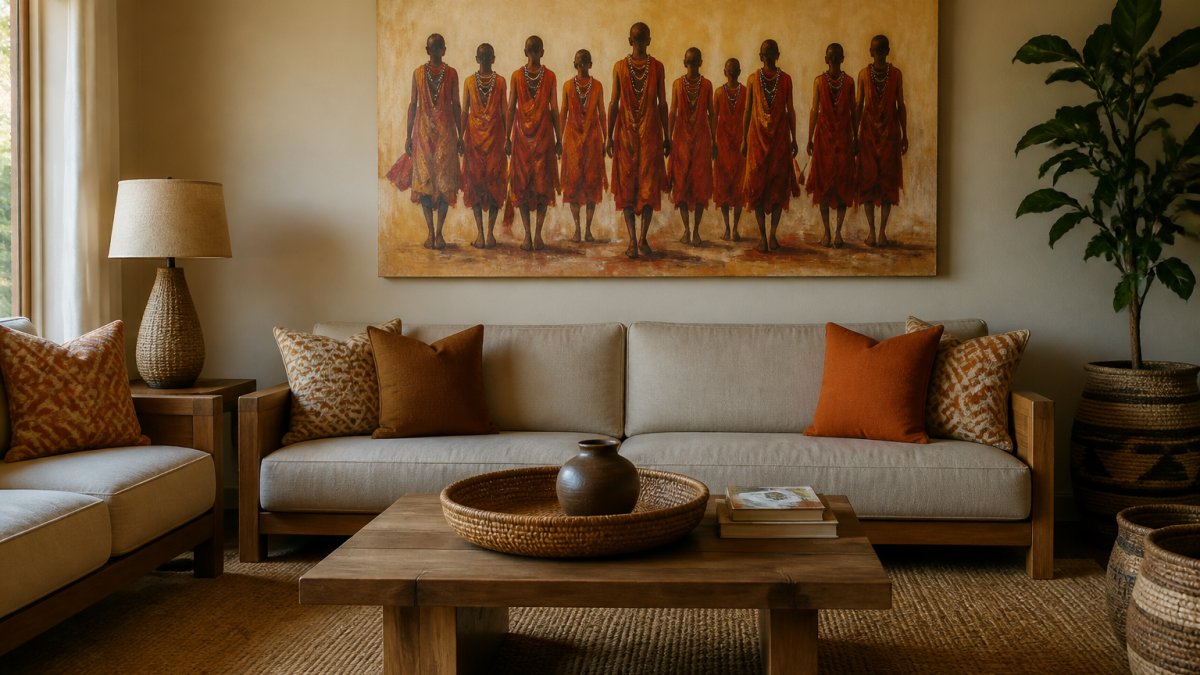
When selecting maasai wall art, look for pieces that resonate with your style while honoring the subject matter. The African Warrior Maasai Canvas Painting from Simcha African Safaris Limited captures the strength and dignity of Maasai culture at $175.99, a centerpiece that commands attention without overwhelming a space.

Canvas paintings work best as focal points:
- Choose one large piece over multiple small ones
- Mount it at eye level, centered on the wall
- Leave breathing room around the piece
- Pair with complementary furnishings in earth tones
Look for authentic Maasai imagery: warriors in traditional dress, cattle herds in savanna landscapes, or ceremonial scenes. Avoid pieces that flatten or stereotype the culture.
Maasai Beadwork Home Décor: Integrating Beaded Pieces Into Your Space
Maasai beadwork home decor brings color and craftsmanship into intimate spaces. Beaded necklaces, collars, and wall hangings showcase intricate work.
Beadwork pieces work in multiple ways:
Wall displays: Frame individual beaded collars or necklaces in shadow boxes to protect them while creating visual interest. Cluster 3-5 pieces for impact, or space them along a hallway.
Shelf styling: Place beaded items on open shelving with books and natural objects. Mix heights and textures. A single dramatic beaded collar draws the eye more than several crowded together.
Accent pieces: Drape a beaded necklace over a mirror frame or artwork. This adds dimension without requiring wall space.
Beadwork's natural materials, glass beads, metal disks, and leather, complement wood furniture and neutral walls, while traditional ochre, deep reds, and blues coordinate with earth-toned décor.
How to Display Handmade Beadwork and Sculptures
Wood sculptures bring three-dimensional presence to a room. The African Maasai Man Sculpture in Mpingo wood ($130.00) and the African Maasai Woman Sculpture ($175.99) from Simcha African Safaris Limited show the skill involved.

Proper display matters:
Placement on surfaces: Position sculptures on level, stable side tables, shelves, or pedestals where they won't be knocked over. A single sculpture commands more attention than a group.
Lighting: Direct light from above or the side reveals wood grain and carving details. Avoid harsh overhead lighting that flattens the piece; a small accent light creates drama.
Spacing: Give each sculpture breathing room. One strong piece on a shelf outperforms three competing for attention.
Height variation: If displaying multiple pieces, vary heights using books or small stands underneath.
Mpingo wood, used for authentic Maasai carvings, darkens beautifully over time, developing character and depth.
Color, Scale, and Placement: Styling Maasai Art in Different Rooms
Most guides stop at "hang it at eye level." A display that works comes down to four measurable variables: size ratio, hanging height, lighting temperature, and color anchoring.
Scale: the one-third rule, with numbers
A common rule of thumb: wall art should occupy roughly 60 to 75 percent of the width of the furniture below it, and about one-third of the wall height. In practice:
- Above a 60-inch sofa, a horizontal canvas in the 40-by-30-inch range reads as a focal point without crowding.
- On a narrow hallway wall under 36 inches wide, keep pieces 12 to 18 inches wide and space them 2 to 4 inches apart so the grouping reads as one unit.
- In a small bedroom, a 16-by-20-inch piece above a dresser is usually the ceiling before the room feels heavy.
Hanging height: the 57-to-60-inch standard
Museum convention places a piece's center at 57 to 60 inches from the floor, aligning with average eye level.
Lighting: match the Kelvin to the palette
Maasai beadwork and paintings lean on ochre, deep red, cobalt, and white. Light temperature changes how those read:
- 2700K to 3000K (warm) amplifies reds, oranges, and ochre, which suits beadwork and earth-toned canvases.
- 3500K to 4000K (neutral) keeps blues and whites accurate, better for pieces with heavy cobalt or white beadwork.
- Above 4000K, colors flatten and wood grain looks gray.
Color anchoring: pull, don't match
African Warrior Maasai Canvas Painting →
Don't buy throw pillows in the exact bead colors. Pull one secondary hue from the piece and repeat it once or twice elsewhere.
Room-by-room, with specifics
- Living room: One large canvas as the anchor, seating arranged to face it. If the sofa is against the wall, leave 8 to 12 inches of breathing room on each side of the art.
- Bedroom: A single beaded wall hanging or a modest sculpture on the dresser. Skip the gallery wall; intimacy beats volume here.
- Hallway: Even spacing and consistent height create rhythm. A 6-foot hallway with three pieces works at roughly 18 inches between centers.
- Home office: A painting above the desk at the 57-to-60-inch centerline, paired with a warm 3000K task lamp, keeps the palette coherent on video calls.
Renter-friendly and small-space options
Command-style strips rated for the piece's weight (typically 4 to 16 pounds) let you hang beadwork and light canvases without nails.
Caring for Beaded Artwork and Handcrafted Pieces
Handmade pieces require gentle care to preserve their beauty.
Beadwork care:
- Dust with a soft brush monthly
- Avoid water and humidity
- Keep away from direct sunlight
- Store in a cool, dry place if not displayed
- Never attempt to clean with liquids
Wood sculpture maintenance:
- Dust regularly with a soft, dry cloth
- Apply furniture polish sparingly, once yearly
- Avoid temperature fluctuations and extreme humidity
- Keep away from heating vents and air conditioning
- Never use harsh chemicals or excessive water
Canvas painting preservation:
- Dust gently with a soft brush
- Avoid touching the painted surface
- Hang away from kitchen steam and bathroom moisture
- Use UV-protective glass if framing
- Keep away from direct sunlight to prevent fading
If one becomes damaged, consult a conservator rather than attempting DIY repairs.
Authenticity, Ethical Sourcing, and Respectful Display
Most décor articles wave at "buy authentic" and move on.
Maasai-made vs. Maasai-inspired: know which you're buying
These are not the same product, and honest sellers say so.
- Maasai-made means the piece was created by a Maasai artisan or Maasai-owned workshop. Beadwork is often made by women's cooperatives that pool income for school fees, livestock, and household needs.
- Maasai-inspired means a designer, often outside the community, borrowed motifs, colors, or silhouettes. That can be legitimate design, but it should be labeled as inspired, not sold as traditional.
A simple question at the point of sale: "Who made this, and where?" If the seller can't name a workshop, region, or artisan, treat the piece as inspired until proven otherwise.
Provenance: what to ask and what to expect
Provenance is the documented story of where a piece came from. For handmade Maasai work, a reasonable paper trail includes:
- The artisan's or cooperative's name and region.
- The date or approximate period of production.
- The materials used and their source (Mpingo wood).
- For resold or vintage pieces, any prior owner history.
Ask for this in writing, a reputable seller will provide at least a short certificate or receipt noting maker and origin.
Fair compensation: what to look for
No single certification guarantees fair pay, but these signals are worth asking about:
- Direct sourcing language. Sellers who buy directly from cooperatives or artisan workshops can usually describe the relationship and how long it's existed.
- Named cooperatives or workshops. If the seller can name the group, you can often verify it independently.
- Pricing that reflects labor. If a piece is priced like a mass-produced import, it probably is one.
- Fair trade membership. Some sellers belong to fair trade networks that require audits and minimum-price guarantees. Ask whether the seller is a member of any recognized fair trade body.
You don't need a perfect answer to every question, you need a seller who answers without deflecting.
Signs of handcraft vs. mass production
- Slight irregularities in bead spacing, color transitions, or carving depth.
- Natural variation in leather tone, wood grain, or bead finish.
- Weight and balance that feel substantial in the hand.
- Tool marks on wood carvings that follow the grain rather than a uniform machine cut.
Respectful display and accurate attribution
Maasai art represents specific people, clans, and traditions. A few practical habits:
- Label accurately. If you know the maker or region, note it on the back of the frame or on a small card nearby. "Maasai beadwork, [region], [maker or cooperative]" is more respectful than "African wall art."
- Don't mix with generic "tribal" décor. Pairing a genuine Maasai collar with mass-produced novelty items flattens the meaning of both.
- Avoid stereotype framing. Skip captions or marketing language that reduces the work to "warrior" or "safari" clichés. Describe the piece by its form, materials, and origin.
- Give it context.
- Consider where it lives. A piece with ceremonial or community significance deserves a setting that treats it as art, not a themed prop.
If you're buying as a gift or reseller
Pass along the provenance you received, include the maker's name, region, and cooperative details with the piece. That habit does more to keep attribution accurate than any label on the front.
Frequently Asked Questions
What are traditional Maasai art pieces, and what do they represent?
Traditional Maasai art pieces include handcrafted beadwork, wood carvings, paintings, and sculptures that reflect the cultural identity and heritage of the Maasai people. Beaded jewelry features vibrant geometric patterns and color symbolism tied to social status, protection, and celebration. Wood carvings, often made from mpingo wood, depict warriors and women in traditional dress. Paintings capture Maasai landscapes, wildlife, and daily life. Each piece carries cultural meaning and represents centuries of artistic tradition passed through generations.
How can I tell if Maasai art is handmade and authentic?
Authentic handmade Maasai art shows visible signs of individual craftsmanship: slight variations in bead placement, natural color inconsistencies, hand-carved details, and unique brushstrokes. Ask your source for provenance information and the artisan's story. Mass-produced pieces appear uniform and lack the organic irregularities of handcrafted work. Authentic wood carvings have natural grain variations and tool marks, while paintings show individual artistic expression rather than template replication.
Where should I display Maasai art in my home for the best visual impact?
Living rooms and bedrooms are ideal spaces for Maasai wall art and sculptures. Place larger canvas paintings as focal points above sofas or accent walls where they draw the eye naturally. Position beaded wall art and smaller sculptures on floating shelves or display stands at eye level. Use adequate lighting, track lights or spotlights enhance the vibrant colors and intricate details. Avoid direct sunlight to prevent fading. Group complementary pieces together or space them strategically to create visual balance without overcrowding.
How do I care for and preserve Maasai beadwork and handcrafted pieces?
Dust beaded artwork gently with a soft, dry cloth every few weeks. Avoid water, harsh chemicals, and direct sunlight, which can fade natural dyes and loosen beads. For wood carvings, use a lightly dampened cloth only if needed, then dry immediately. Store pieces away from humidity and temperature fluctuations. Beaded jewelry should be kept in a cool, dry place. Handle all pieces with clean hands to prevent oil transfer and discoloration.


