

Table of Contents
- Why Authentic Artisan Markets in Tanzania Belong on Your Itinerary
- Best Authentic Artisan Markets in Tanzania for Travelers
- Tanzania Local Craft Markets: What to Expect
- Tanzanian Souvenirs to Buy: From Beadwork to Wood Carvings
- How to Bargain in Tanzania: Fair Prices and Ethical Purchasing
- How to Assess Authenticity and Craftsmanship
- Practical Visitor Tips: Prices, Payments, and Getting There
- Shipping, Customs, and Taking Crafts Home
- Frequently Asked Questions
Last Updated: October 8, 2026
Why Authentic Artisan Markets in Tanzania Belong on Your Itinerary
Authentic artisan markets in Tanzania for travelers offer the most direct route into the country's living culture. They are working markets where makers sell what they make, not staged showrooms built around tour buses.
Most guides treat markets as a shopping stop squeezed between safari days.
Below: the markets worth your time, what to pay, how to bargain fairly, and how to get purchases home.
Best Authentic Artisan Markets in Tanzania for Travelers
The strongest artisan markets cluster around Arusha, the northern safari circuit, Dar es Salaam, and Zanzibar. Pick by itinerary, not reputation.
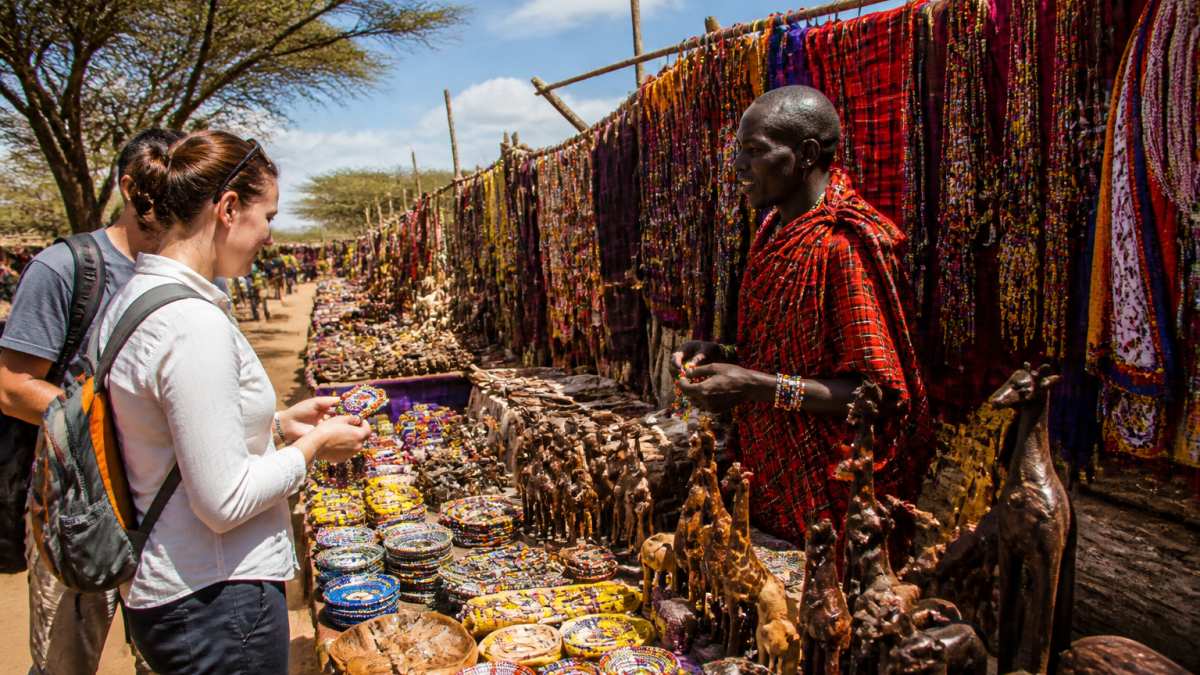
Maasai Market in Arusha
Arusha's Maasai Market is the most accessible craft market for safari travelers, close to the town center and northern circuit gateways. Vendors specialize in Maasai beadwork, sandals, shukas, and hand-carved pieces. It is tourist-friendly without feeling staged, and you meet artisans directly rather than through a middleman. Go in the morning for the widest selection.
Mto wa Mbu Market Near Lake Manyara
Mto wa Mbu is a farming and craft town on the road to Lake Manyara and Ngorongoro. Its market draws local shoppers and travelers, which keeps prices grounded. You find woven baskets, fabrics, and carvings alongside everyday produce, it serves residents first, so it feels like a real street market, not a curio stop.
Kariakoo Market in Dar es Salaam
Kariakoo is Dar es Salaam's sprawling commercial heart and the least tourist-oriented market here. Come for kitenge and kanga fabric and everyday crafts at local prices. It is bustling, loud, and crisscrossed by narrow aisles, bring patience, keep valuables close, and go with a guide on a first visit.
Stone Town Curio Markets in Zanzibar
Stone Town's curio markets and the nearby Darajani area mix Swahili, Arab, and Indian influences. Expect carved doors, spice boxes, paintings, jewelry, and woven goods. It is the most walkable market experience in the country and pairs easily with a beach stay.
Tanzania Local Craft Markets: What to Expect
Tanzania local craft markets are informal, social, and high-energy. Vendors call out, invite you to look, and often start a conversation before a price, normal, not aggressive by local standards.
A few things to plan for:
- Timing: Most markets are busiest in the morning and late afternoon. Weekends draw larger local crowds.
- Cash: Carry small bills. Cards are rarely accepted at individual stalls.
- Crowds: Narrow aisles and heavy foot traffic are standard. Wear closed shoes.
For a calmer browse, ask your guide for the quieter hours, fewer tourists means more relaxed vendors and better conversations.
Tanzanian Souvenirs to Buy: From Beadwork to Wood Carvings
Tanzanian souvenirs to buy range from beaded jewelry to carvings, textiles, and paintings. The best pieces are handmade, signed when possible, and priced to reflect the work behind them.
What to look for:
- Maasai beadwork: Colorful necklaces, bracelets, and belts, often made by women's cooperatives.
- Wood carvings: Bowls, spoons, figurines, and masks carved from local hardwoods.
- Traditional textiles: Kitenge and kanga fabric, plus woven baskets.
For collectors who want real provenance, we offer handcrafted pieces directly through Simcha African Safaris Limited, including the African Tribal Maasai Traditional Mask carved from mpingo wood, and the Zanzibar in African Oil Canvas Painting depicting Stone Town.


How to Bargain in Tanzania: Fair Prices and Ethical Purchasing
Bargaining in craft markets is expected, but the goal is a fair exchange, not a win. Treat negotiation as a short conversation about the work, not a contest over the last dollar.
Anchor the price before you counter
Opening quotes in tourist-facing markets are set high enough to absorb two or three rounds of negotiation. Experienced buyers often counter at roughly half the opening figure, then settle at 60 to 75 percent for small items and closer to 80 percent for large, labor-intensive pieces.
Useful anchors to keep in mind:
- Small beaded bracelets and keychains: a few dollars each; multi-buy discounts are normal.
- Mid-size carvings, bowls, and figurines: tens of dollars, scaling with size and wood density.
- Large masks, stools, and canvases: the highest tier, and the tier where walking away over a few dollars is a bad trade for both sides.
Treat every opening number as a starting point, not an insult.
Separate artisan-direct stalls from reseller stalls
This is the most useful skill for ethical purchasing. Artisan-direct sellers usually share three signals:
- They can describe the maker, the material, and the time invested, often because they are the maker or a family member.
- Their inventory is uneven. A carver selling six bowls will show variation in grain and finish; a reseller's table looks factory-uniform.
- They sell one craft family well rather than a little of everything. A stall with beadwork, carvings, paintings, and textiles at identical quality is usually a middleman.
Buying from a reseller keeps more money in the resale chain; buying artisan-direct sends more to the maker. Neither is wrong, just know which you are doing.
Pay for time, not just for the object
Ask how long a piece took to make. A hand-carved mpingo mask can represent days of work; a hand-strung beaded collar, hours. That shifts the negotiation from "how low can I push this" to "what is a fair return on that time." Adding a modest amount above the settled price for a piece you love is remembered, and often repaid with a better price next time.
Negotiate without erasing the maker
A few habits keep the exchange respectful:
African Tribal Maasai Traditional Mask →
- Never open with a counter below the cost of materials. If you cannot tell what the materials cost, ask.
- Do not insult the work to justify a low offer. Critique is not a bargaining tool here.
- Walk away politely if the price is wrong for you. Storming off ends the conversation and the relationship.
Know when not to bargain
Fixed-price situations exist and should be respected: cooperative shops, museum stores, some women's cooperative stalls, and any vendor who states a firm price up front. Bargaining there reads as ignorance or disrespect. When in doubt, ask whether the price is fixed, most sellers will tell you plainly.
The ethical bottom line
A fair price is one both sides would accept again. If you leave feeling you got a steal, the artisan likely feels the same about you. The better outcome: a piece you are proud to own, from a person you can describe, at a price that reflects the hours behind it.
How to Assess Authenticity and Craftsmanship
Authenticity shows up in small details: tool marks, slight irregularities, and the weight of real hardwood. Mass-produced imports look identical and feel light.
Check these signs:
- Wood: Genuine mpingo and other hardwoods are dense and heavy. Ask what the piece is carved from.
- Beadwork: Hand-strung beads vary slightly in size and spacing. Machine work is uniform.
- Paintings: Look for brush texture and a signature. Prints have a flat, glossy surface.
If a seller cannot tell you who made a piece or where it came from, treat that as your answer.
Practical Visitor Tips: Prices, Payments, and Getting There
Most market guides stop at "bring cash and go in the morning." These details change how a market day goes.
Opening days and hours
Market schedules vary by city and type, and shift around public holidays, so confirm with your hotel or guide the day before. As a general pattern:
- Arusha's Maasai Market operates daily, with the widest selection and coolest temperatures in the morning. Afternoon crowds thin, but so does inventory.
- Mto wa Mbu Market is a working town market. It is busiest in the early morning when residents shop for produce, and craft stalls fill in through mid-morning. Sundays tend to be quieter for crafts.
- Kariakoo in Dar es Salaam runs six days a week and is heaviest on weekday mornings. Plan around the midday heat and the evening rush.
A reliable rule across all of them: arrive within the first two hours of opening for first pick, cooler air, and vendors not yet fatigued by a day of haggling.
Getting there
- Arusha: The Maasai Market sits close to the town center and is reachable by short taxi ride from most hotels. Agree on the fare before you get in, and confirm whether the price is one-way or round-trip.
- Mto wa Mbu: Most travelers pass through on the road between Arusha and Lake Manyara or Ngorongoro. If you are on a safari route, ask your driver to build in a stop rather than treating it as a detour.
- Kariakoo: Use a licensed taxi or a guide-arranged driver. The market is large enough that being dropped at the wrong edge adds a long walk. Have your driver note a specific pickup point and time.
Prices and what things actually cost
Prices in craft markets are negotiable and vary by city, stall, and season. Rather than quote figures that go stale, plan in tiers:
- Small beadwork and souvenirs: a few dollars each; multi-buy pricing is standard.
- Mid-size carvings, baskets, and textiles: tens of dollars, scaling with size and material.
- Large carvings, masks, and paintings: the top tier, and the tier where shipping and customs planning matters most.
Tourist-facing markets in Arusha and Stone Town open higher than working markets like Mto wa Mbu and Kariakoo. For local pricing, shop where locals shop.
Payments
- Cash is king. Individual stalls rarely accept cards, and mobile money is common among locals but not always offered to visitors.
- Carry local currency in small bills. Breaking a large note at a stall is difficult and often costs you on the exchange.
- US dollars are widely accepted but not always fairly. If you pay in dollars, expect change in local currency at a rate that favors the vendor. Ask the shilling price first and decide which is better.
Safety and navigating crowds
- Keep phones and cash out of back pockets. Front pockets or a crossbody bag worn under a layer is safer.
- Split your money between two places so a single loss does not end your day.
- Narrow aisles and heavy foot traffic are normal. Move with the flow rather than against it.
Accessibility
Market lanes are generally unpaved, uneven, and crowded, which makes them difficult for wheelchairs, strollers, and travelers with mobility limitations. Stone Town's curio area is the most walkable of the group. If accessibility is a priority, ask your guide to identify the flattest entry point and the least crowded hours, and consider a guided visit so someone else handles navigation.
If you are booking a safari with us, we can build market time into your route so you are not rushing between game drives and stalls.
Shipping, Customs, and Taking Crafts Home
Shipping and customs rules are where souvenir purchases go sideways. Plan for them before buying anything large.
For travelers returning to the United States, U.S. Customs and Border Protection sets personal exemption limits and duty rules, and those figures change, so check the current amounts on the U.S. Customs and Border Protection personal exemptions page before you travel.
Practical steps:
- Ask vendors to wrap carvings in bubble wrap and cardboard for checked luggage.
- Keep every receipt. Customs officers may ask for proof of value.
- Avoid raw plant material, seeds, and untreated wood, which can be restricted.
| Purchase Type | Packing Approach | Customs Consideration |
|---|---|---|
| Small beadwork | Carry-on, padded pouch | Generally exempt under personal allowance |
| Wood carvings | Bubble wrap, checked bag | Declare value, keep receipt |
| Paintings | Rigid tube or flat pack | Declare value, keep receipt |
| Textiles | Rolled, vacuum bag | Generally straightforward |
Shopping in Tanzania's artisan markets rewards travelers who slow down and buy with intention. The challenge is fitting market time into a packed safari itinerary without cutting into game drives, that is where we come in.
Frequently Asked Questions
What are the best artisan markets to visit in Tanzania?
The Maasai Market in Arusha is a top choice for beadwork, while Mto wa Mbu near Lake Manyara offers a mix of crafts and fresh produce. In Dar es Salaam, Kariakoo Market is bustling with local goods, and Stone Town in Zanzibar has curio markets with carvings and textiles. Each market provides a unique cultural experience and a chance to meet artisans.
How do you bargain at markets in Tanzania?
Start by greeting the vendor politely and asking about their craft. Offer a price that is about half of the initial asking price, then negotiate calmly. Walking away is acceptable if the price feels too high. Remember that bargaining is expected, but always keep it friendly and respectful. A fair deal benefits both you and the artisan.
What handmade items should I look for in Tanzania?
Look for Maasai beadwork, mpingo wood carvings, woven baskets, traditional textiles like kitenge, and oil paintings. Mpingo wood is prized for its strength and dark color. Masks and sculptures from tribes such as the Maasai and Chagga are also popular. These items reflect local heritage and make meaningful souvenirs.
Can travelers bring Tanzanian crafts home in their luggage?
Yes, most crafts can be packed in checked luggage. However, items made from protected species like ivory or certain woods may be restricted. Check U.S. customs regulations before you travel. It's wise to declare any agricultural or wildlife products. For large or fragile items, ask the vendor about shipping options and costs.
How can I tell whether a Tanzanian craft is handmade?
Examine the item for slight irregularities, tool marks, and unique details that indicate handcrafting. Ask the vendor about the materials and the artisan who made it. Authentic pieces often come with a story. Avoid items that look identical and mass-produced. Supporting local artisans ensures you get genuine craftsmanship.


