

Table of Contents
- Tanzania Safari Booking Timeline: How Far in Advance to Book
- How Many Days for a Tanzania Safari: Duration Options
- Step-by-Step Planning Checklist for 2026 Travel
- Tanzania Safari Cost Breakdown 2026
- Best Time to Visit: Peak Season and Migration Patterns
- Essential Documents and Health Requirements
- Sample Itineraries: What 5-10 Days Looks Like
- Frequently Asked Questions
Last Updated: September 20, 2026
Tanzania Safari Booking Timeline: How Far in Advance to Book
Effective Tanzania safari planning starts with a booking timeline 6-9 months ahead for peak season because national parks limit capacity, internal flights operate on fixed schedules, and lodges book solid months in advance.
Why the 6-9 Month Window Exists
Park permits and vehicle allocations drive the earliest constraint. The Serengeti limits vehicles in each sector to preserve the ecosystem. During peak season (June-October), permits issue first-come, first-served. Operators who don't secure permits by month 6 may be unable to offer Serengeti dates.
Lodge occupancy fills in waves. Luxury lodges in the Serengeti often book to 80-90% capacity by month 7 for peak-season departures. Once full, you must accept an alternative lodge or reschedule.
Internal flight schedules lock in around month 5-6. Small aircraft operate on fixed weekly rotations. Missing this window may force 2-3 day gaps between parks, adding cost and travel time.
International flights from the United States to Tanzania typically require booking 8-12 weeks in advance for peak-season departures. Fares run $800-1,400 when booked 3-4 months out, but spike to $1,200-1,800 if booked within 6 weeks.
Timeline by Season
Peak season (June-October): Book 8-9 months in advance to secure park permits and lodge availability.
Shoulder seasons (April-May, November-December): Book 5-6 months in advance. Park permits and lodges have more availability.
Wet season (January-March): Book 3-4 months in advance. Demand is lowest and lodge prices drop 30-50%.
What Happens If You Miss the Window
Month 7-8 for peak season: Park permits may still be available, but expect alternative circuits like Tarangire-Lake Manyara instead of Serengeti-Ngorongoro.
Month 9-10 for peak season: Internal flights become constrained and lodge availability narrows to budget and mid-range properties.
Within 4 weeks of departure: Last-minute bookings incur 15-25% premiums and internal flights cost $1,600-2,000 per person instead of $150-300.
The Booking Sequence
- Month 1: Define dates and preferences. Contact 2-3 operators for availability.
- Month 2: Secure international flights.
- Month 3: Commit to safari operator and sign booking agreement.
- Month 4-5: Confirm internal flights and finalize itinerary.
- Month 6: Complete visas, vaccinations, and travel insurance.
2026 Booking Calendar
- June 2026 departures: Commit to operator by September 2025. Book international flights by July 2025.
- July-August 2026 departures: Commit by October 2025. Book flights by August 2025.
- September-October 2026 departures: Commit by November 2025. Book flights by September 2025.
- November-December 2026 departures: Commit by June 2026. Book flights by September 2026.
- January-March 2027 departures: Commit by October 2026. Book flights by November 2026.
How Many Days for a Tanzania Safari: Duration Options
A Tanzania safari duration ranges from 3 to 10 days, but 5-7 days is ideal for most travelers. 3-day safaris work only if you're already in the region. 5-day safaris offer two solid days of game drives in major parks with time to recover from jet lag. 7-10 day safaris let you visit multiple parks; a 7-day trip might combine the Serengeti with Ngorongoro Crater, while 10 days adds Zanzibar or Mount Kilimanjaro. Wildlife photographers need minimum 7 days; couples often prefer 5-7 days.
Step-by-Step Planning Checklist for 2026 Travel
Breaking down Tanzania safari planning into months makes the process manageable and prevents last-minute scrambling.
Month 1: Research and Vision
Define your priorities: wildlife viewing vs. cultural immersion, luxury lodges vs. tented camps, and budget range. Research major circuits: the Serengeti offers migration patterns, Ngorongoro Crater concentrates wildlife, Tarangire attracts elephant herds, and Lake Manyara combines wildlife with scenic landscapes. Review sample itineraries from established operators like Simcha African Safaris Limited. Check visa requirements; most travelers need a visa, which takes 2-4 weeks to process.
Months 2-3: Secure Logistics
Contact safari operators with your dates, group size, and preferences for customized quotes. Book international flights to lock in better pricing. Start your visa application (2-4 weeks). Schedule health appointments: yellow fever vaccination takes effect 10 days after injection; malaria prophylaxis starts 1-2 days before arrival.
Months 4-5: Finalize Details
Confirm your safari operator and sign the booking agreement. Book internal flights within Tanzania. Purchase travel insurance covering trip cancellation, medical emergencies, and evacuation (5-8% of trip cost). Confirm vaccinations and pick up malaria prophylaxis.
Tanzania Safari Cost Breakdown 2026
Safari costs vary dramatically based on accommodation type, park selection, and group size.
Accommodation is the largest expense: luxury lodges $400-800/night, mid-range $150-300/night, tented camps $100-250/night, budget camps $50-100/night. Park entrance fees run $60-80/day. Guide and vehicle costs typically $150-250/day for private 4x4 or $40-60/day per person for group tours. Internal flights cost $150-300 per flight. Meals range $20-50 depending on accommodation. Travel insurance costs $150-400 for 7 days. A realistic 5-day safari for two runs $3,000-6,000; a 7-day trip costs $4,500-9,000 (mid-range accommodations, private guiding).
| Expense Category | Budget Option | Mid-Range | Luxury |
|---|---|---|---|
| Accommodation (per night) | $50-100 | $150-300 | $400-800 |
| Park Fees (per day) | $60-80 | $60-80 | $60-80 |
| Guide & Vehicle (per day) | $40-60 | $150-250 | $250-400 |
| Meals (per day) | $15-25 | $30-50 | $50-100 |
| Internal Flights | $150-300 each | $150-300 each | $150-300 each |
Best Time to Visit: Peak Season and Migration Patterns
Peak season (June-October) offers the best wildlife viewing but requires advance booking. The Great Migration moves through the Serengeti in phases: June-July crosses the Grumeti River, August-September reaches the northern Serengeti and Masai Mara, and October brings the return journey south. Ngorongoro Crater concentrates wildlife year-round; dry season (June-October) provides best viewing. Tarangire attracts massive elephant herds during dry season, with October-November seeing the largest concentrations.
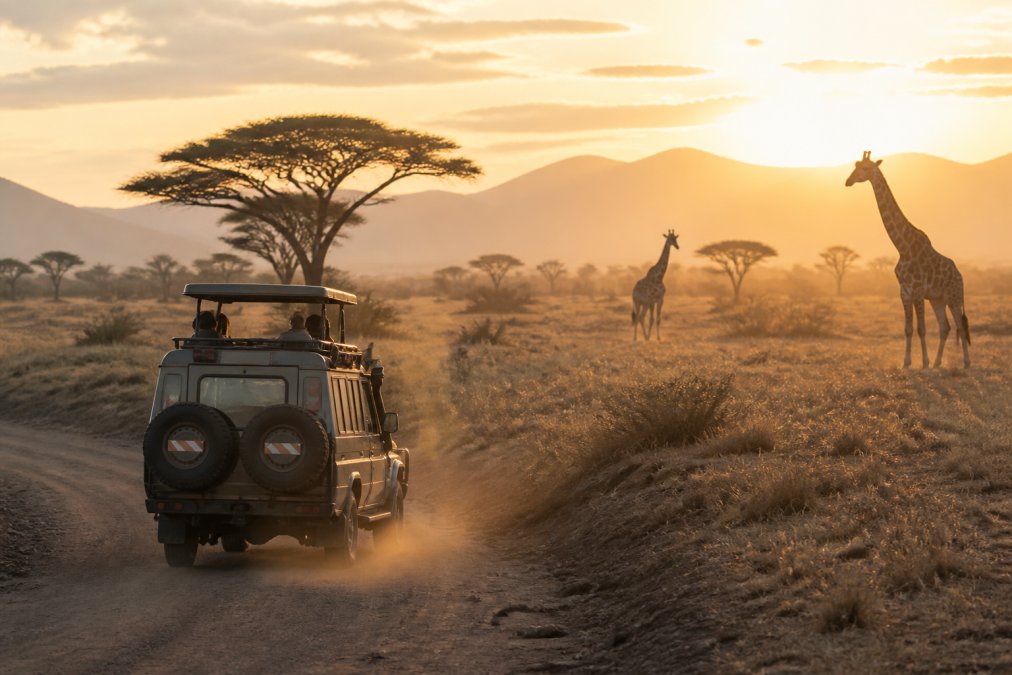
The wet season (November-May) offers advantages most travelers overlook. Vegetation is lush. Birdwatching is exceptional. Accommodation prices drop 30-50%. January-February brings the calving season, creating dramatic wildlife interactions.
Essential Documents and Health Requirements
Your passport must be valid for at least 6 months beyond your travel dates.
Visa requirements vary by nationality. United States citizens need a visa, obtainable on arrival or in advance. Advance visas take 2-4 weeks through the embassy or online services. On-arrival visas cost roughly $50-100 but require longer processing at the airport.
Zanzibar in African Oil Canvas Painting →
Yellow fever vaccination is strongly recommended and required by some insurance policies. The vaccine takes effect 10 days after injection.
Malaria prophylaxis should start 1-2 days before arrival and continue for 4 weeks after departure. Your doctor will recommend chloroquine, atovaquone-proguanil, doxycycline, or mefloquine based on your health profile.
Travel insurance should cover medical evacuation. Remote areas have limited medical facilities. Evacuation to Dar es Salaam or Kenya can cost $10,000-50,000 without insurance.
Bring copies of your passport's biographical page. Store originals separately from copies. Keep digital copies in cloud storage.
Accessibility and Mobility Considerations
Vehicle and seating: Standard safari vehicles are open-sided 4x4s with elevated seating accessed by a side step (typically 18-24 inches high). Vehicles have no wheelchair accessibility. If you use a wheelchair or have difficulty with steps, confirm with your operator whether they offer vehicles with lower entry points or modified seating. Request this accommodation when you first contact operators, don't assume it's available.
Game drive duration and pace: Standard game drives last 4-6 hours with minimal breaks. If you have joint pain, back issues, or fatigue-related conditions, discuss modified itineraries with your operator. Some lodges offer shorter 2-3 hour drives or allow you to rest at the lodge during midday heat.
Terrain and walking: Game drives involve unpaved roads with significant bumping and dust.
Pre-Departure Health Planning
Schedule a consultation with a travel medicine clinic 4-6 weeks before departure. Travel clinics specialize in tropical diseases, altitude exposure, and remote-area medicine.
Sample Itineraries: What 5-10 Days Looks Like
Day 1: Arrive in Dar es Salaam or Kilimanjaro. Overnight in a city hotel.
Day 5: Full day Serengeti game drive. Evening departure.
A 7-day itinerary adds depth:
Days 1-2: Arrival and rest.
Day 7: Ngorongoro Crater game drive. Evening departure.
A 10-day itinerary combines multiple parks with cultural experiences:
Days 1-2: Arrival and rest.
Days 3-4: Tarangire National Park.
Days 5-7: Serengeti National Park (three full days).
Day 8: Ngorongoro Crater.
Frequently Asked Questions
How far in advance should you book a Tanzania safari for 2026?
Book 4-6 months ahead for peak season travel (June-October). This lead time ensures availability at your preferred national parks and lodges, gives you time to arrange flights and visas, and allows for any customizations. Last-minute bookings are possible but limit your options and may cost more. For shoulder seasons (April-May, November), 2-3 months is typically sufficient.
How many days should I spend on a Tanzania safari?
Most visitors spend 5-7 days on safari to see the Big Five and experience multiple ecosystems like the Serengeti, Ngorongoro Crater, and Lake Manyara. A 3-4 day itinerary works for time-constrained travelers but reduces wildlife viewing opportunities. Longer 10-day trips combine safari with cultural experiences, Kilimanjaro climbing, or Zanzibar beach time. Your ideal duration depends on your interests, fitness level, and available vacation time.
What documents do I need for a Tanzania safari in 2026?
U.S. citizens need a valid passport (6+ months validity), a Tanzania visa (obtainable on arrival or in advance), and proof of yellow fever vaccination if traveling from certain countries. Malaria prophylaxis is recommended for most regions; consult your doctor 4-6 weeks before travel. Travel insurance covering medical evacuation is highly advised. Check current CDC and State Department guidance before booking.
What is the best month to visit Tanzania for safari?
June through October (dry season) offers the best wildlife viewing, cooler temperatures, and lower malaria risk. The Great Migration peaks July-September in the Serengeti. November-December brings fewer crowds and lower prices but occasional rain. January-February is warm and dry with good wildlife viewing. Avoid April-May (heavy rains) and March (unpredictable weather). Your choice depends on migration patterns, budget, and crowd preferences.


