

Table of Contents
- Timing Your Trip: Best Time of Year and Ngorongoro Crater Safari Duration
- Best Camera Gear for Safari: Lenses, Bodies, and Support
- Permits, Fees, and Logistics for Ngorongoro Crater Photography
- Safari Photography Tips for Beginners: Settings, Etiquette, and Field Craft
- Crater Floor Logistics: Game Drive Timing and Vantage Points
- Accommodation Near the Crater: Where to Stay for Early Starts
- Post-Processing Workflow for Safari Images
- Frequently Asked Questions
Last Updated: September 13, 2026
Timing Your Trip: Best Time of Year and Ngorongoro Crater Safari Duration
Learning how to plan a wildlife photography trip to Ngorongoro Crater starts with two decisions that shape everything else: when you go and how long you stay. The dry season, roughly June through October, delivers the most reliable game viewing because short grass and limited surface water concentrate animals on the crater floor (ncaa.go.tz). The green season, November through May, trades easy sightings for dramatic skies, wildflowers, and far fewer vehicles in your frame.
Plan on a minimum of two full crater days. Most photographers find that the first descent is spent learning light angles and vehicle positioning, while the second produces the portfolio images. A three-night stay near the rim gives you two dawn entries without exhausting transfers.
Simcha African Safaris Limited builds itineraries from three to seven days, so a photography-focused schedule can be stretched to include the wider conservation area rather than the crater alone.
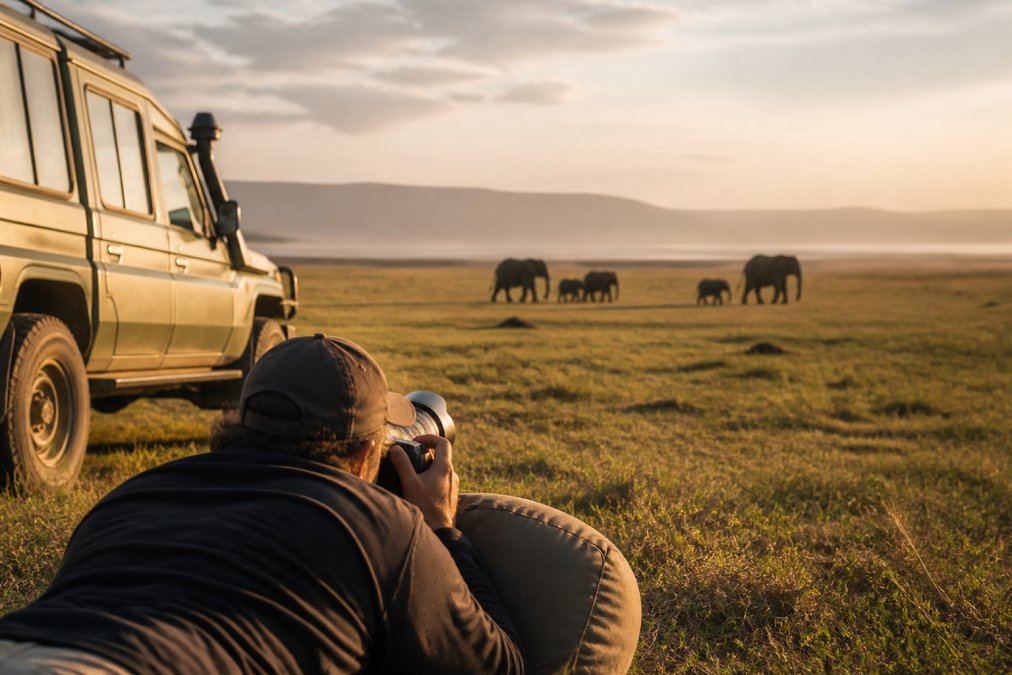
Best Camera Gear for Safari: Lenses, Bodies, and Support
The best camera gear for safari balances reach, light gathering, and weight. A body with strong high-ISO performance matters more than megapixels here, because dawn on the crater floor is genuinely dark and animals rarely wait for the sun.
Bring two bodies if you can. Swapping lenses in a dusty vehicle is how sensors get ruined, and the crater floor is one of the dustiest environments you will ever photograph in.
Telephoto vs. Wide-Angle: Focal Length Comparisons
| Focal Length | Typical Use | Crater Floor Reality |
|---|---|---|
| 70-200mm | Vehicle-side portraits, landscapes with context | Ideal for lions and elephants near the track |
| 100-400mm | General wildlife work, handheld flexibility | The single most useful range for most photographers |
| 400-600mm | Distant subjects, compressed backgrounds | Essential for rhino and distant predators |
| 16-35mm | Wide-angle landscape, vehicle interiors | Best at rim viewpoints and sunrise over the caldera |
A 100-400mm zoom covers the majority of crater sightings. Add a 1.4x teleconverter for the long end, and pack a wide-angle for the rim.
Battery and Storage Management in Remote Areas
Power and card space are the two resources photographers run out of first. Charge every battery each night, carry at least three spares per body, and disable in-camera Wi-Fi and GPS to cut drain. For storage, shoot RAW to dual cards where possible, and bring a portable SSD plus a card reader rather than relying on a single laptop. Copy and verify every evening, and never format a card until the files exist in two places.
Permits, Fees, and Logistics for Ngorongoro Crater Photography
Crater access is not a single ticket. It is a stack of separate charges administered by the Ngorongoro Conservation Area Authority (NCAA), and understanding the stack is what separates a smooth trip from an expensive surprise at the gate.
The Four Charges You Will Actually Pay
Most photographers assume one fee covers the crater. In practice, a crater day typically involves four distinct line items:
- Conservation area entry, a per-person, per-day fee to enter the Ngorongoro Conservation Area at all.
- Crater service (descent) fee, a separate per-person, per-day charge that applies only on days you go down to the floor. This is the fee people forget, and it is charged per descent day, not per descent.
- Vehicle fee, a per-vehicle charge, usually tied to the vehicle's seating capacity, paid by the operator.
- Concession or camping fees, only if you are staying inside the conservation area rather than at a lodge outside it.
Because these are set by the NCAA and revised periodically, treat any figure you read online, including in this article, as a starting point, not a quote. Confirm current amounts and accepted payment methods directly with the NCAA or your operator before you commit to a budget. A common pattern is for operators to quote a single "crater day" rate that bundles all four; ask for the itemized breakdown so you can see what happens if you add a second descent day.
How Crater Access Is Actually Booked
Crater-floor access is not unlimited. The NCAA manages the number of vehicles permitted on the floor at any one time, which is why descent slots are allocated rather than simply purchased on arrival. In practice this means:
- Your operator reserves a descent slot for a specific morning or afternoon window.
- The vehicle must be registered and the permits issued before the gate opens.
- Your driver-guide carries the paperwork; you generally do not handle permits yourself as a leisure visitor.
This is the mechanism behind the advice to book the first morning slot. It is not just about light, it is about slot availability. During peak dry-season weeks, late-booked travelers are sometimes offered an afternoon descent instead of a dawn one, which costs them the best two hours of the day.
Filming Permits vs. Personal Photography
Personal still photography for non-commercial use does not require a separate filming permit (tanzaniaparks.go.tz). Commercial filming and professional productions do, and the NCAA issues those permits separately with their own fees and conditions. The practical trigger is intent and use, not gear: a photographer with a 600mm lens shooting for themselves is a tourist, while a small crew shooting for a brand is a production. If your work will be licensed, sold, or used in advertising, arrange the correct permit through your operator in advance rather than explaining yourself at the gate.
Logistics Worth Locking Down Before You Fly
- Descent time slot, request the first morning window in writing.
- Vehicle allocation, confirm you have a private vehicle, not a shared one, if you want to control positioning and dwell time at a sighting.
- Full-day vs. half-day on the floor, a full day requires the guide to hold the right permits and to carry food and water; confirm this is planned.
- Payment method, some fees are payable by card at the gate and some are not; confirm before you rely on a card.
- Trip purpose documentation, carry a simple letter from your operator stating the trip is personal photography if you are traveling with heavy professional-looking gear.
Safari Photography Tips for Beginners: Settings, Etiquette, and Field Craft
Safari photography tips for beginners usually focus on settings, but field craft decides more of your results. Learn your camera before you fly, so that exposure changes happen without taking your eyes off the scene.
Essential Camera Settings for Wildlife
Start in aperture priority at f/5.6 to f/8 for most wildlife, and switch to manual once light stabilizes. Keep shutter speed at or above 1/1000s for moving animals, and raise ISO before you drop shutter speed. Use continuous autofocus with animal eye detection if your body offers it. Underexpose slightly to protect highlights on pale animals in harsh light, then lift shadows in editing.
Safari Vehicle Etiquette and Ethical Guidelines
Stay in the vehicle unless your guide says otherwise, keep your voice low, and never ask a driver to leave the track for a closer angle. Ethical wildlife photography means the animal's behavior comes first: if your presence changes what it is doing, you are too close. Avoid flash on nocturnal or shy species, and never block another vehicle's sightline.
Crater Floor Logistics: Game Drive Timing and Vantage Points
Timing on the crater floor is everything, but "go at dawn" is not a plan. What matters is the sequence: which part of the floor you work first, how the light moves across the caldera wall, and how your focal length changes what a sighting actually looks like.
A Workable Dawn-to-Dusk Sequence
A common pattern among photographers who shoot the crater repeatedly is to treat the day as three distinct light phases rather than one long game drive:
- First light to roughly two hours after sunrise, predators are most active and the floor is coolest. Work the open grasslands and the areas near the Lerai Forest edge, where lions and hyenas are often still moving. Light is low, so this is your high-ISO window.
- Mid-morning to midday, the light flattens and hardens. This is the window for elephants and buffalo near water, and for behavioral sequences rather than portraits. Many photographers use this period to scout positions for the afternoon rather than to shoot heavily.
- Late afternoon to gate close, side-lighting rakes across the crater wall and gives the best separation between subject and background. This is when the classic crater images are made, and it is also when you want to be positioned with the sun at your back and the wall behind your subject.
Why Vantage Point Is a Focal-Length Decision
The crater is roughly 10 to 12 miles across, and that scale changes what each lens actually delivers (usgs.gov). A useful way to think about it:
- At 100mm, an animal 30 to 40 yards away fills a reasonable portion of the frame with habitat context. This is your "animal in the landscape" focal length, and it is the one most photographers underuse on the floor.
- At 200mm, a subject at roughly 50 to 60 yards becomes a clean portrait with the crater wall compressed behind it.
- At 400mm, you are working subjects 80 to 100 yards out, distant rhinos, a cheetah on a termite mound, predators that will not tolerate a vehicle close.
- At 600mm, atmospheric haze becomes the limiting factor more often than reach. On warm afternoons, heat shimmer over the floor can soften a 600mm frame at 150 yards more than a 400mm frame at 100 yards.
The practical takeaway: on the crater floor, a 100-400mm zoom covers more usable situations than a fixed 600mm, because the floor's scale and the vehicle's positioning constraints mean you are often closer than you expect, and because heat haze punishes extreme reach.
Positioning the Vehicle
Ask your guide to position the vehicle with the sun behind you whenever the sighting allows it. On the crater floor this usually means the vehicle sits between the sun and the subject, which puts the light on the animal's face rather than behind it. When the sighting is against the crater wall, the opposite applies, you want the wall as a dark backdrop and the animal lit from the side.
Low angles matter too. Shooting from the vehicle window at eye level with a low subject compresses the background and removes the vehicle's roofline from the frame. A bean bag on the window sill is more useful on the crater floor than a tripod, which is impractical inside a vehicle and often not permitted outside it.
Accommodation Near the Crater: Where to Stay for Early Starts
Staying on or near the rim is the single biggest advantage a photographer can buy. Rim lodges put you at the descent gate before the convoys arrive, and the altitude gives you cool mornings and clear air. Properties just outside the conservation area are cheaper but add an hour or more each way, which costs you the best light.
Book early for the dry season, when rim rooms sell out months ahead. If you are combining the crater with other parks, a night on the rim before your crater day is worth more than an extra night elsewhere.
Post-Processing Workflow for Safari Images
A repeatable editing workflow saves more images than any lens. Import to a catalog, cull hard for sharpness and behavior, then apply a consistent base: lens correction, white balance, and a modest tone curve. Lift shadows carefully, because crater images often carry heavy contrast between bright sky and shaded animals.
Apply noise reduction before sharpening, and sharpen for output rather than for the screen. Keep a preset for dusty, low-contrast mornings and another for harsh midday light, then finish with a light vignette to draw the eye.
If you want a physical reminder of the trip, Simcha African Safaris Limited offers handcrafted pieces such as the African Heritage Sculpture, an elephant carved from Mpingo wood that sits well beside a framed crater print.

Frequently Asked Questions
How many days do you need in the Ngorongoro Crater for wildlife photography?
For a focused photography trip, plan at least two full days inside the crater. One day lets you scout and shoot the main game drive loops, while the second gives you time to return to productive spots during golden hour. If you can stretch to three days, you will have better odds of catching the Big Five in good light and can also explore the wider conservation area. Most photographers find two to three days strikes the right balance between depth and cost.
What camera gear is essential for a safari in the Ngorongoro Crater?
A camera body with good dynamic range and weather sealing is a solid start. Pair it with a telephoto lens (200-500mm on full-frame) for wildlife and a wide-angle for landscapes. Bring a bean bag support for vehicle shooting, extra batteries, and plenty of memory cards. Dust protection for your gear is critical, as the crater floor can be dusty. A monopod can help with heavy lenses, but tripods are often impractical inside safari vehicles.
How do I secure photography permits for the Ngorongoro Crater?
Photography for personal use does not require a special permit beyond standard conservation fees, which are paid per vehicle and per person. If you are shooting commercially, for stock, or with professional film equipment, you must apply for a filming permit through the relevant Tanzanian authorities before your trip. Your safari operator can handle the paperwork and fees. Always confirm current requirements with your tour company at least two months before departure.
What are the best vantage points for photography inside the crater floor?
The Lerai Forest area offers excellent elephant and bird photography, especially in the morning. The Ngoitokitok Springs attract hippos and waterbirds, making it a good spot for behavioral shots. For wide-angle landscape photography, the viewpoints along the crater rim at sunrise are unbeatable. On the floor, the open grasslands near the Munge Stream are productive for capturing predators and their prey in golden hour light. Your guide can position the vehicle for the best angles.
Planning a photography trip to the crater means juggling timing, permits, gear, and light, and getting any one of them wrong costs you images you cannot reshoot. Simcha African Safaris Limited handles the logistics so you can focus on the frame, with expertly guided game drives in iconic parks, curated itineraries from three to seven days, and access to UNESCO World Heritage sites where the Big Five still roam. Request a quote and build a crater itinerary around the light, not around the crowds.


