

Quick Summary
Whale shark photography works best when you prepare before the trip: choose a wide-angle setup, test your housing for leaks, and set a baseline of fast shutter speed, moderate aperture and low ISO before entering the water. Keep the animal at the distance your guide sets and let it come to you, since chasing produces blurry, rushed shots.
- Test your housing in a sink or pool and check the O-rings before you travel.
- A wide-angle lens fits large animals in frame and reduces the effect of murky water.
- Start at 1/250 second or faster, around f/5.6 to f/8, and ISO 200-400 in bright sun.
- Shoot bursts of 3-5 frames and use continuous autofocus on the animal's body or eye.
- Respect your guide's distance rules, never chase or touch the shark, and let it approach you.
Table of Contents
- Choosing a Compact Camera or Phone Setup
- Selecting the Best Lens for Underwater Photography of Whale Sharks
- Setting Your Camera for Changing Water and Light
- Composition and Framing Shots With Whale Sharks and People
- Staying Safe and Respectful While You Shoot
- Editing and Selecting Your Best Whale Shark Photos
- Booking Your Whale Shark Tour and Planning Your Shots
- Frequently Asked Questions
Preparing Your Underwater Camera Before the Tour
Planning a whale shark swim in Tanzania? Strong underwater photography tips for whale shark tours start long before you get in the water.
Whale shark photography is different from most reef work. The animals are large, they move steadily, and they often pass close to the surface, which means your camera has to handle changing light and fast reactions. A little preparation can help prevent common mistakes.
Choosing a Compact Camera or Phone Setup
A compact camera or a modern smartphone is a practical choice for many snorkelers. Both are light, affordable to replace, and easy to use in the water. Many travelers find that a phone with a waterproof case works well for close, wide shots on calm days.
- Compact cameras with a fast lens tend to handle low light better
- Phones need a rated waterproof case, often rated to a set depth
- Check your battery life, since cold water drains batteries faster
Keep it simple. A camera you can operate without thinking will capture more moments than a complicated rig you struggle to use.
Choosing a Housing and Testing It Before the Trip
If you use a dedicated camera, you will need a housing rated for the depth you plan to reach. Snorkeling usually stays near the surface, but the housing still has to keep water out completely, so test it before you travel.
Test it in a sink or pool first. Check the O-rings, clean them, and add a thin coat of silicone grease. Then look for any sign of moisture inside the housing after a short soak.
Selecting the Best Lens for Underwater Photography of Whale Sharks
The best lens for underwater photography of whale sharks is usually a wide-angle lens. Whale sharks are large, and you often need to fit the whole animal in the frame while you are close.
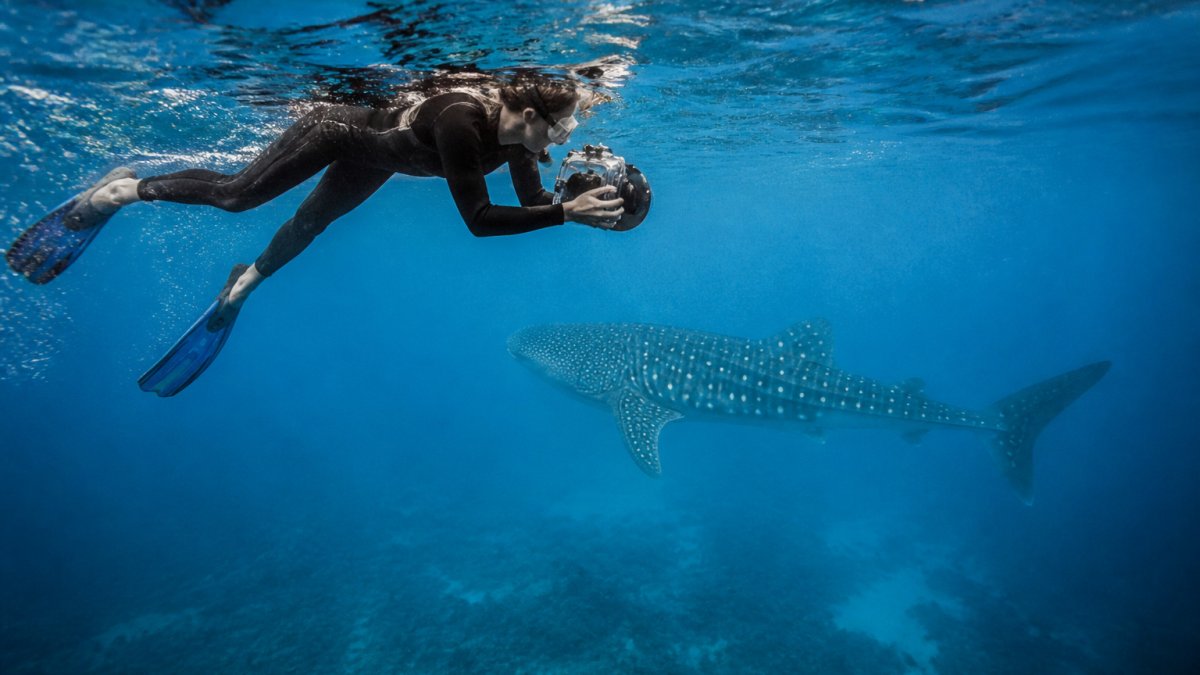
Many photographers choose a wide-angle lens for this kind of shooting. Check the specifications of your camera or phone before you buy or rent.
- Wide-angle lenses fit large animals and reduce the effect of murky water
- Shorter focal lengths make it easier to shoot without disturbing the animal
- Zoom lenses can help for small details, but they are harder to use in open water
Zoom lenses can be harder to focus in open water.
Setting Your Camera for Changing Water and Light
Whale shark encounters happen in bright, shifting surface water, and that is exactly where generic underwater settings fail. The unique angle here is tour-specific starting points: dial these in on the boat, then make small adjustments in the water rather than fumbling with menus while a shark passes.
Starting Settings for Bright Surface Water
Use these as a baseline for a compact camera, phone app, or interchangeable-lens rig, then adjust one variable at a time:
- Shutter speed: Start at 1/250 second or faster. Whale sharks cruise steadily but swimmers and fins move quickly; 1/250 freezes most motion, and 1/500 is safer when the animal is close and passing fast.
- Aperture: Start around f/5.6 to f/8 on a dedicated camera. This keeps the animal's eye and spotted skin sharp while giving you a little depth of field for a swimmer in the frame. Compacts and phones often have a fixed or narrow aperture range, so lean on shutter speed and ISO instead.
- ISO: Start at ISO 200-400 in bright sun and raise to 800 only when the animal moves into shade or deeper water. Higher ISO adds noise, and underwater noise is harder to clean up than on land.
Reading the Light on a Whale Shark Tour
Surface glare, sun angle, and water color change minute to minute. A few patterns are worth planning for:
- Shoot with the sun behind or beside you when you can. Front-lighting the animal brings out the spotted pattern; shooting straight into the sun creates glare and silhouettes the shark.
- Watch the surface reflection. A low camera angle near the surface can pick up a bright band of glare across the top of the frame. Tilt slightly downward or reposition to keep glare out of the shot.
- Expect color shift with depth. Near the surface, water looks blue-green; a few feet down it turns bluer and darker. If your camera has an underwater white-balance preset, use it, and correct the rest in editing.
Adapting as Conditions Change
Crowding, visibility, and sun angle shift throughout a tour, so plan your settings around the conditions rather than a single ideal shot:
- Low visibility: Move closer only if the animal allows it, widen the aperture slightly, and avoid zooming, which magnifies haze.
- Crowded water: Raise shutter speed to 1/500 to freeze other swimmers' fins, and frame tighter to keep strangers out of the shot.
- Changing sun angle: Re-check exposure every few minutes; a cloud passing over the sun can drop light by a stop or more.
Locking in a safe baseline before the encounter lets you spend more time composing rather than adjusting.
The article's starting settings for bright surface water can be summed up in a quick reference table.
| Setting | Starting point | Adjust when |
|---|---|---|
| Shutter speed | 1/250 second or faster | Use 1/500 when the animal is close and passing fast |
| Aperture | f/5.6 to f/8 | Compacts and phones may have a fixed range |
| ISO | 200-400 in bright sun | Raise to 800 in shade or deeper water |
| Autofocus | Continuous (AF-C) | Place focus point on the body or eye |
| Burst mode | 3-5 frames per burst | Avoid holding the shutter down |
| File format | RAW if available | Preserves highlight detail in glare |
Composition and Framing Shots With Whale Sharks and People
Good composition makes a whale shark photo feel like a story.
Try a low angle when you can. Shooting from slightly below the animal shows its shape and makes the moment feel more dramatic.
- Leave space in front of the animal's direction of travel
- Include a swimmer or the boat for scale when it helps the story
- Keep the horizon level and avoid cutting off the animal's tail
Remember that the animal sets the pace. Let it come to you, and swim alongside at a calm speed. Chasing a whale shark usually produces blurry, rushed photos.
Staying Safe and Respectful While You Shoot
Safety and ethics are not separate from good photography on a whale shark tour, they are what make good photos possible. If you meet local communities, read how to respectfully photograph Indigenous tribes before you raise a camera. The unique angle here is snorkel-tour logistics: how to manage a camera while entering and exiting the water, follow guide instructions, and photograph responsibly without crowding the animal or other swimmers.
Managing Your Camera Entering and Exiting the Water
Most whale shark tours are snorkel-based, and the riskiest moments for your gear are the entry and exit, not the encounter itself:
- Hand your camera down or secure it before you jump. A wrist strap or float handle prevents a dropped rig, and handing the camera to a crew member is safer than jumping with it in hand.
- Turn the camera on and check the housing seal before boarding, not in the water. A quick look at the O-ring and a test shot on deck catches problems early.
- Enter feet-first and calmly. Splashing and sudden movements can startle the animal and dislodge your mask or camera.
Following Guide Instructions and Distance Rules
Whale shark tours operate under rules designed to protect the animal and the swimmers. Follow your guide's instructions even when you want a closer frame:
- Respect the distance your guide sets. Follow the distance your guide sets, and approach the animal calmly.
- Do not chase, touch, or block the animal (Marine Life Viewing Guidelines: Guidelines And Distances). Chasing produces rushed, blurry photos and stresses the shark; let it come to you and swim alongside at a calm pace.
- Limit time near the animal. If your guide signals you to rotate out, do so promptly, other swimmers are waiting, and the animal needs space.
Ethical Wildlife Photography in Practice
Responsible photography means putting the animal's behavior ahead of your shot list:
- Never touch or ride the animal, and do not use flash if your guide prohibits it.
- Do not crowd or surround the shark with other swimmers; a single calm photographer gets better frames than a cluster.
- Watch for stress signals such as sudden dives or changes in direction, and back off when you see them.
A Quick Pre-Tour Camera Checklist
Run through this before you board, so logistics never cost you a shot:
- Batteries charged and a spare packed (cold water drains batteries faster)
- Memory card formatted and a spare on hand
- Housing O-rings clean, greased, and seated; housing tested for leaks
A few minutes of preparation on deck protects your gear, keeps you on the right side of your guide's rules, and lets you focus on the encounter instead of your equipment.
Editing and Selecting Your Best Whale Shark Photos
Editing turns good raw files into images you will want to keep and share. Start by choosing your strongest shots and deleting near-duplicates, which saves time later.
Basic adjustments usually make the biggest difference. Correct the white balance so the water looks natural, lift shadows gently, and reduce haze if the water looked cloudy. Avoid heavy filters, since they can make underwater scenes look artificial.
- Cull your photos the same day while the memories are fresh
- Compare images side by side to find the sharpest frame
- Back up your files to two places, such as a drive and cloud storage
Booking Your Whale Shark Tour and Planning Your Shots
Planning your shots starts when you book. To plan your timing, see the guide to the best months for whale shark diving.
Simcha African Safaris Limited offers combination trips that pair whale shark swimming with a Tanzania safari, so you can plan both wildlife experiences in one journey. For current prices and availability, request a quote from Simcha African Safaris Limited.
Before you go, pack your gear, test it, and confirm the plan with your team. Then you will be ready to capture your own whale shark story.
Last Updated: October 29, 2026
Frequently Asked Questions
What camera settings are best for underwater whale shark photography?
Shoot in manual or shutter-priority mode with a fast shutter speed, typically around 1/250 second or faster, to freeze the animal's movement. Keep ISO as low as the light allows, often between 200 and 800 in bright surface light, and raise it only when needed. Use a moderately wide aperture such as f/5.6 to f/8 for enough depth of field, and shoot in RAW so you can correct white balance and color later. Check your settings before each swim because light changes quickly between the surface and deeper water.
How do you keep underwater photos from looking blue?
Water absorbs red light first, so photos taken at a distance look blue and flat. Get closer to the whale shark, since shorter subject distance preserves more color. Use a red or color-correction filter if your housing supports one, or use a strobe to add light back into the scene. Shooting in RAW lets you restore warmth during editing, and setting a custom white balance underwater helps the camera's color rendering.
Should you use a flash when photographing whale sharks?
A strobe can add color and detail, especially in deeper or cloudier water, but it is not always needed in bright, shallow conditions. Strobes can also backscatter light off particles in the water, creating white specks, so position the light arm away from the lens. Check your tour operator's rules first.
What should you do if a whale shark swims too close to photograph?
Stay calm, keep your fins still, and let the animal move on rather than chasing it. Do not touch the whale shark or block its path, and keep your camera steady rather than fighting for a close frame. Follow your guide's distance instructions, which protect both you and the animal.


