

Last Updated: October 23, 2026
Quick Summary
Educational wildlife activities for kids on safari turn a family game drive into a moving classroom where every sighting becomes a lesson in animal behavior, habitats, and conservation. We build wildlife activities for kids into family itineraries because children learn faster when they are tracking, drawing, and asking questions in the field rather than reading about wildlife at home. Every activity gives a child a job to do.
- Run a wildlife scavenger hunt for the first 45 minutes of the drive, then let it go.
- Build the hunt in three tiers: easy finds, medium finds, and rare finds.
- Teach four track shapes: the round cat paw, cloven hoof, three-toed bird foot, and five-fingered primate hand.
- Rule a field journal page into four boxes: date and time, sketch, animal behavior, and a question.
- Keep toddler sessions under 15 minutes with picture-only cards and no writing.
Table of Contents
- Why Safari Activities for Kids Turn a Game Drive Into a Classroom
- Wildlife Scavenger Hunt for Kids: A Checklist That Builds Observation Skills
- Animal Track Identification for Kids: Reading the Ground Like a Guide
- Safari Field Journal for Kids: Recording Wildlife Like a Junior Ranger
- Hands-On Animal Crafts and Art Projects That Reinforce Learning
- Educational Wildlife Activities for Kids: Age and Ability Adaptations
- Wildlife Safety and Ethical Viewing for Families on Safari
- Frequently Asked Questions
Why Safari Activities for Kids Turn a Game Drive Into a Classroom
Educational wildlife activities for kids on safari turn a family game drive into a moving classroom where every sighting becomes a lesson in animal behavior, habitats, and conservation.
A game drive rewards patience, and patience is a skill most children build through play. When a child spots a kudu in the scrub before the adults do, the trip changes. They stop being passengers and start being naturalists.
Below, we break down the activities we use on family safaris, with materials, steps, and age guidance for each. The common thread: every activity gives a child a job to do.
Wildlife Scavenger Hunt for Kids: A Checklist That Builds Observation Skills
A wildlife scavenger hunt for kids is a printed checklist of animals, tracks, and behaviors that children tick off during a game drive, and it works because it converts passive viewing into active searching. Readers building a checklist want to know which animals they can realistically expect, and our guide to the animals of Ruaha National Park covers exactly that.
Most safari-themed activity lists stop at "make a scavenger hunt." The useful version is a ready-to-run card a caregiver can print before the trip and hand out in the vehicle.
Materials (per child): one printed card, one clipboard, one pencil, one small eraser. Optional: a zip-top bag for found items (leaves, feathers already on the ground, never picked from a plant).
Setup steps:
- Print the card at home or at the lodge before the drive. Choose the tier that matches the park and season.
- Clip the card to the board and write the child's name and the date at the top.
- Agree on the rules in 30 seconds: point, don't grab; stay seated; ask the guide before leaving the vehicle.
- Run the hunt for the first 45 minutes of the drive, then let it go. A hunt that runs all day becomes a chore.
Learning goal: observation and categorization, the child practices sorting what they see into named groups and noticing behavior, not just species.
Build the list in three tiers so every child scores a win early:
- Easy finds: impala, zebra, giraffe, guinea fowl
- Medium finds: elephant, buffalo, warthog, baboon
- Rare finds: leopard, wild dog, lion on a kill
Printable and offline version. Game drives often have no signal, so build the card as a one-page PDF you print before you travel. A simple layout works: three columns (Easy, Medium, Rare), a behavior-bonus box at the bottom, and a blank "mystery find" line for anything the child spots that is not on the list. Print two copies per child, one for the drive, one spare for the lodge. If you cannot print, a blank index card ruled into three rows does the same job.
Age and ability adaptations for the hunt:
- Ages 3-5: picture-only card with four to six large images. No writing; the child points and an adult ticks.
- Ages 6-8: the three-tier card above, with an adult reading the labels aloud.
- Ages 9-12: add a "where was it?" column (grass, woodland, water, rock) and a one-line behavior note.
- Sensory-friendly option: a tactile card with raised shapes or textured stickers the child can trace with a finger, plus a quiet seated version with no points or competition.
A hunt is also the easiest activity to connect to conservation: when a child ticks "rhino" or "wild dog," that is the moment to explain why those species are hard to find and what protects them.
Animal Track Identification for Kids: Reading the Ground Like a Guide
Animal track identification for kids starts with four shapes: the round cat paw, the cloven hoof, the three-toed bird foot, and the five-fingered primate hand. Teach those four and a child can read most of what appears in the dust.
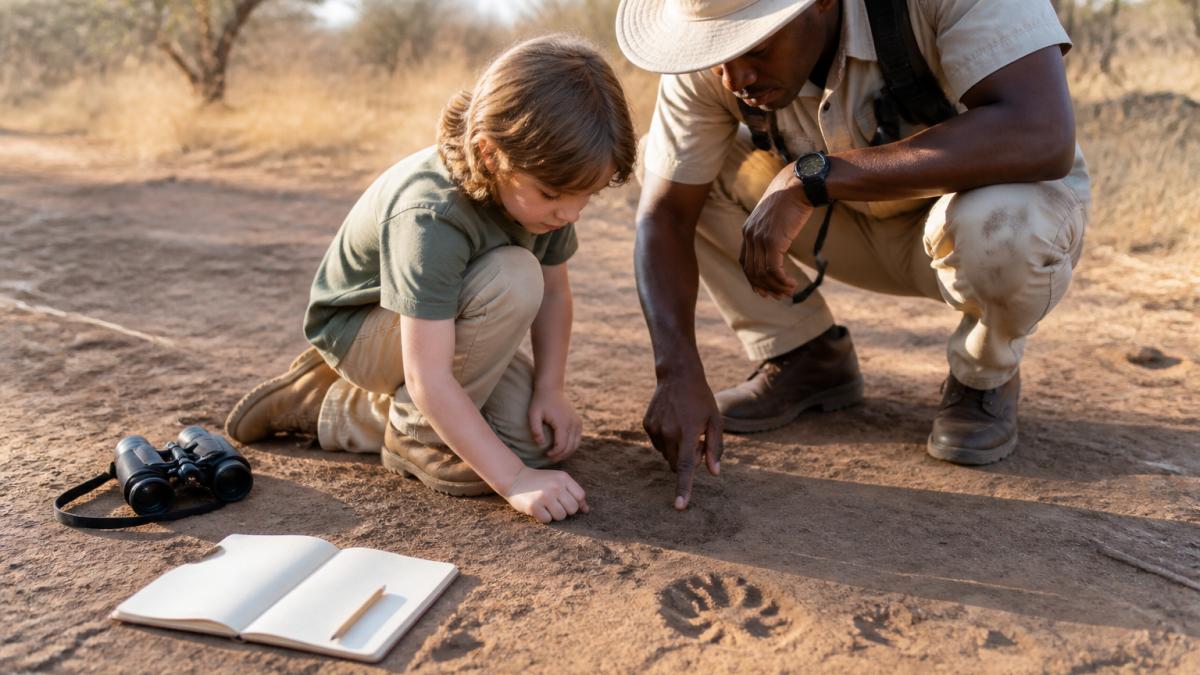
Walk the first hundred meters of any guided walk slowly and let the children lead. Ask three questions at each print: How many toes? Are there claw marks? Which way was the animal moving?
Safari Field Journal for Kids: Recording Wildlife Like a Junior Ranger
A safari field journal for kids is a notebook where a child records each sighting with a sketch, the time, the habitat, and one observation, and it turns a holiday into a junior ranger record they keep for years. Any sturdy notebook works. Rule the page into four boxes: date and time, sketch, animal behavior, and a question to answer later.
Give the journal a structure children can repeat:
- Sketch first, label second. Drawing forces close looking.
- Write one sentence about behavior, not appearance.
- Note the habitat: grass, woodland, water, or rock.
- Add a question for the guide at dinner.
For families who want to add photographs to the journal, our Tanzania wildlife safari photography tips explain how to frame animals from a vehicle without disturbing them.
Sculpture . 5 jungle animals. sculptures. impingo wood sculpture →
Hands-On Animal Crafts and Art Projects That Reinforce Learning
Hands-on animal crafts work best when they mirror what the child saw that morning. A footprint cast, a clay elephant, or a painted track map all force a child to recall details, which is where the learning sticks.
Three projects we recommend for lodge afternoons:
- Plaster track casts. Mix plaster, pour into a clean track, and let it set. Label the species.
- Clay animals. Ask the child to shape one animal from memory, then check a photo. The gap between memory and reality is the lesson.
- Track map painting. Draw the day's route and mark every track and sighting on it.
For families who want craft-based learning built into a fuller trip, our family cultural tour itinerary pairs hands-on workshops with village visits, so children try traditional skills alongside art projects.
Educational Wildlife Activities for Kids: Age and Ability Adaptations
Here is how the core activities scale across age bands, with the specific change to make at each stage:
| Age band | Best activity | Session length | What to change | Learning focus |
|---|---|---|---|---|
| Ages 2-3 (toddlers) | Picture scavenger hunt | 10-15 minutes | Pictures only, no writing; adult holds the card | Naming and pointing |
| Ages 4-5 (preschool) | Picture hunt plus track tracing | 15-20 minutes | Four track shapes, traced with a finger | Shape and pattern recognition |
| Ages 6-8 | Track identification and simple journal | 30 minutes | Four track shapes, guided; three-box journal page | Observation and sorting |
| Ages 9-12 | Field journal and species counts | 45 minutes | Full page, own questions, tally marks | Recording and questioning |
| Teens | Photography and data | Open-ended | Species counts, time-stamped notes, photo log | Data and evidence |
Toddlers (ages 2-3). Keep the session under 15 minutes and make it physical: point, name, repeat. A picture card with four animals is enough.
Preschoolers (ages 4-5). Add one layer, tracing a track shape with a finger or matching a track card to a photo.
Elementary-age children (ages 6-12). This is where journals, tally counts, and behavior notes pay off.
Teens. Shift from crafts to data: species counts per hour, a photo log with times, and a short written comparison of two habitats. This mirrors real field survey methods and keeps older children engaged when sticker activities no longer land.
Sensory-friendly and low-mobility options. Children who find noise, motion, or competition difficult often do best with seated, quiet activities. Practical swaps:
- Replace the clipboard with a tactile track card the child can trace with a finger.
- Replace the group hunt with a solo journal page and a quiet break afterward.
- Replace walking-based track identification with a vehicle-based "spot from your seat" card.
- Offer a screen-free option for lodge downtime: a printed coloring page of local tracks, or a blank notebook for drawing what was seen that morning.
- Keep sessions short and predictable, and give a five-minute warning before ending.
Parents planning which parks and lodges suit children of different ages will find our family friendly safari lodges and national parks guide useful for matching camp style to your family.
Wildlife Safety and Ethical Viewing for Families on Safari
Wildlife safety on safari comes down to three rules for children: stay in the vehicle unless a guide says otherwise, keep voices low near animals, and never try to get an animal's attention. Ethical viewing means the animal's behavior comes first, and a family that follows this sees more, not less.
Teach children to read stress signals. An elephant flapping its ears and swaying is uneasy. A baboon showing its teeth is warning you. When an animal changes behavior because of your vehicle, the guide should back off, and children should see that decision being made.
Families who want to travel lightly and responsibly can read more in our eco friendly safari travel practices guide, which covers waste, water, and respectful viewing in practical terms.
A family safari only becomes a classroom when the activities are planned before you arrive, not improvised in the vehicle.
Frequently Asked Questions
What can kids learn about wildlife on safari?
Kids can learn animal identification, behavior, habitats, and adaptations through guided observation. A wildlife scavenger hunt for kids teaches them to spot tracks, scat, and feeding signs, while a safari field journal for kids helps them record what they see. These educational wildlife activities for kids build observation skills, vocabulary, and a conservation mindset that lasts long after the trip.
How can kids safely observe animals on safari?
Keep children inside the vehicle unless a guide says it is safe to exit, and maintain a quiet voice so animals are not disturbed. Use binoculars to watch from a distance, and never ask a child to feed or touch wildlife. A guide will position the vehicle for safe viewing, and children can record observations in a safari field journal for kids without getting closer.
What should children bring on a safari?
Pack a small backpack with a wildlife scavenger hunt for kids checklist, a safari field journal for kids, colored pencils, binoculars, a hat, sunscreen, and a refillable water bottle. A camera or tablet for photography is optional. Bring closed-toe shoes for guided walks and a light jacket for early morning game drives.
How do you make a safari educational for kids?
Turn each game drive into a learning moment by asking questions about animal behavior and habitats. Use a wildlife scavenger hunt for kids to focus attention, practice animal track identification for kids during guided walks, and set aside time each evening to write in a safari field journal for kids. Hands-on animal crafts and drawing sessions reinforce what they saw.
What wildlife activities can kids do without disturbing animals?
Observation-based activities are best: sketching animals from the vehicle, completing a wildlife scavenger hunt for kids checklist, and practicing animal track identification for kids on designated walking paths. Quiet photography and journaling also work well. Always follow your guide's instructions on distance and noise, and never leave the vehicle to approach wildlife.


