

Table of Contents
- What Is the Great Migration?
- Why Do Wildebeest and Zebra Migrate?
- The Migration Route and Ecosystem
- Best Time to See the Great Migration
- Month-by-Month Breakdown of the Annual Cycle
- Tanzania Safari Logistics for Migration Viewing
- Wildlife Spectacle: The Herds and Predators
- Ethical Wildlife Viewing and Conservation
- Frequently Asked Questions
Last Updated: September 25, 2026
What Is the Great Migration?
The Great Migration Serengeti is one of the most extraordinary wildlife events on Earth. Every year, roughly two million wildebeest, zebra, and gazelle move in a circular pattern across the Serengeti-Mara ecosystem in a relentless search for fresh grazing lands and water. This isn't a one-directional journey, it's a continuous annual cycle that defines the rhythm of life across the African plains.
The herds follow rainfall patterns and the emergence of new grass, creating a clockwise migration route that spans over 1,800 miles. What makes the Great Migration Serengeti truly remarkable is its scale and the drama of river crossings, predator encounters, and the raw power of nature unfolding at massive herd density.
Multiple species work in tandem: wildebeest graze heavily on grass, zebra prefer rougher vegetation, and gazelle fill ecological niches the others leave behind. This grazing sequence benefits the ecosystem by managing vegetation and creating pathways for other species.
Why Do Wildebeest and Zebra Migrate?
The driving force behind the migration is simple: survival. Wildebeest and zebra are grazers entirely dependent on fresh, nutrient-rich grass and reliable water sources. When the dry season arrives in one region, the grass withers and water disappears. The herds must move or starve.
Rainfall patterns dictate everything. During the wet season, the southern Serengeti becomes lush and green, drawing massive herds to calving grounds. As rains move north, the animals follow, tracking mineral-rich pastures that emerge wherever rain has recently fallen.
Predators keep herds moving and prevent overgrazing: lions, leopards, hyenas, and African wild dogs have shaped the migration route over thousands of years, creating a natural balance that sustains both hunted and hunters.
The annual cycle is relentless with no permanent settlement. Calves are born weak and defenseless yet must move within hours, shaping the entire ecosystem's timing and behavior.
The Migration Route and Ecosystem
The migration route is a clockwise loop across the Serengeti-Mara ecosystem: herds begin in the southern Serengeti, move north through central plains, cross into the Mara region, and circle back south as seasons shift.
The Serengeti-Mara ecosystem contains diverse habitats, grasslands, woodlands, riverine corridors, and water sources, that provide different resources at different times of year and sustain millions of large herbivores.
The Mara River Crossing
The Mara River crossing is the most dramatic moment of the entire migration. Hundreds of thousands of wildebeest and zebra gather at the riverbanks, hesitating before plunging into crocodile-infested waters. The river crossing happens multiple times throughout the year as the herds move back and forth, but the most intense crossings occur during the northward movement.
When herds commit to crossing, animals pile into the water; some drown in the crush, others fall prey to massive Nile crocodiles. Thousands perish, but millions survive and reach the Mara's fresh grazing lands.
The river crossing represents the migration's most vulnerable moment and most essential transition, transforming the ecosystem through nutrient deposits and vegetation changes.
Best Time to See the Great Migration
The dry season (June through September) brings the northward migration and the dramatic Mara River crossings. This is peak season for safari operators and travelers. The herds are concentrated around water sources, making them easier to locate. Predator activity intensifies as well, creating more frequent wildlife encounters.
The calving season (November through December) concentrates herds in the southern Serengeti. Millions of wildebeest give birth within a few weeks, creating an intense period of vulnerability and predation. This is a powerful time to witness the raw cycle of life and death, though it's less crowded than the dry season.
The wet season (March through May) scatters the herds across the southern plains as they disperse to feed on newly sprouted grass. This period offers a different experience, fewer crowds, greener landscapes, and a more intimate view of the migration's quieter phases.
Month-by-Month Breakdown of the Annual Cycle
Understanding the monthly progression helps travelers plan their visit strategically. Here's how the migration unfolds across the calendar year:
January-February: Herds remain in the southern Serengeti on mineral-rich pastures; calves born in November-December are now mobile but vulnerable to predators.
March-May: Wet season rains bring grass emergence and northward movement; fewer tourists but lower visibility.
June-July: Northward migration accelerates with intense Mara River crossings; peak season, expensive, crowded, but dramatic.
August-September: Herds concentrated in Mara region with multiple river crossings; intense predator activity.
October: Herds begin southward journey as rains arrive in southern Serengeti.
November-December: Calving season in southern Serengeti; hundreds of thousands of calves born within weeks; peak predation.
Big five mask. African Mask. Mask. →
Tanzania Safari Logistics for Migration Viewing
Planning a safari to see the Great Migration requires understanding both the operational realities and the financial and logistical trade-offs involved. Most online guides gloss over the practical details, but independent travelers need concrete information to make informed decisions.
Park Entry and Permits
The Serengeti National Park charges a non-resident vehicle entry fee of approximately $50 USD per vehicle per 24 hours, plus a per-person park fee of roughly $60 USD daily. The Masai Mara National Reserve in Kenya charges similar rates. These fees are non-negotiable and must be paid in advance or at park gates, though advance payment through registered operators is more reliable.
A Tanzania wildlife permit is required for all visitors and is typically included in package tours but costs $50 USD if obtained independently. Visitors also need a valid passport with at least six months validity and, for most nationalities, a Tanzania tourist visa (approximately $50 USD for a single-entry visa, obtainable on arrival or in advance).
Transportation Options and Trade-offs
Guided Safari Operators: Established companies handle logistics and provide trained guides; 5-day safaris range $2,000-$5,000 USD per person. Peak dry season (June-September) commands premium pricing; wet season (March-May) offers 30-50% discounts with reduced visibility.
Self-Drive Safaris: Rent a four-wheel-drive vehicle ($80-150 USD daily) and navigate independently. This saves operator markups but introduces risks: breakdowns, limited wildlife information, and difficulty locating herds. Most self-drivers hire local guides ($30-50 USD daily).
Road Conditions: Main roads are passable year-round; wet season (March-May) renders secondary roads impassable. Southern gate to Mara River crossing takes 6-8 hours. Fuel is limited; plan refueling carefully.
Accommodation Spectrum
Accommodations range from budget ($40-80 USD) to ultra-luxury ($500+ USD). Mid-range ($150-300 USD) offers best value. Mobile camps cost more but position you closer to herds. Book 2-3 months ahead for peak season.
Timing and Seasonal Logistics
Dry season (June-September) offers concentrated wildlife and dramatic crossings but crowded drives and high prices. Wet season (March-May) offers lower prices and fewer tourists but scattered herds. Calving season (November-December) balances fewer tourists with dramatic predation events.
Practical Considerations
Most travelers arrive via Julius Nyerere International Airport in Dar es Salaam (4-5 hours by road or 1 hour by domestic flight). Domestic flights cost $200-400 USD. Travel insurance is strongly recommended; medical evacuation can cost $10,000+ USD.
Guides registered with TATO or KPSGA have formal training in wildlife behavior and conservation ethics. Unregistered guides may offer lower rates but lack accountability and may engage in unethical practices.
Arrange water, food, and supplies in advance. Self-drivers must carry sufficient supplies; shops near parks are limited and expensive. Cellular coverage is minimal.
Wildlife Spectacle: The Herds and Predators
The migration is fundamentally about predator-prey dynamics played out at an enormous scale. The herds attract predators from across the ecosystem, creating some of nature's most intense hunting scenarios.
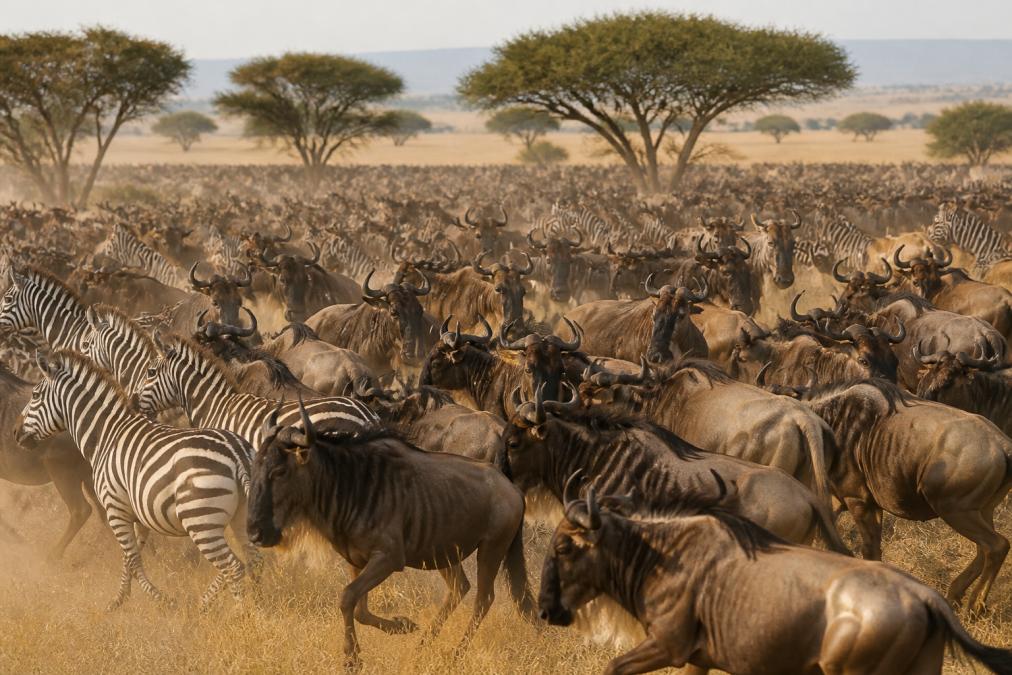
Wildebeest form the migration's backbone, resilient and capable of long-distance travel.
Ethical Wildlife Viewing and Conservation
Witnessing the Great Migration comes with responsibility to both wildlife and the ecosystem. Ethical viewing practices and understanding the conservation challenges, especially those driven by climate change, are essential for sustainable tourism.
Responsible Wildlife Viewing Practices
Maintain 20 meters distance from most wildlife; 25 meters from predators and elephants. Never approach on foot. Avoid operators that leave marked roads or habituate animals through repeated close contact.
- Drive off-road to pursue animals or position vehicles for photographs
- Encourage feeding or touching of wildlife
- Operate during sensitive periods (calving season) in ways that stress mothers and calves
- Use artificial calls or distress sounds to attract predators
- Operate without permits or in protected areas during closure periods
Climate Change and Shifting Migration Patterns
This variability has measurable consequences:
Calving Timing: Historically, most wildebeest calves were born in November-December, synchronized with peak wet season. Unpredictable rainfall now desynchronizes births, reducing survival advantages and increasing predation and malnutrition.
Conservation Priorities and Community Support
The Great Migration's survival depends on habitat protection, anti-poaching efforts, and sustainable land use in the broader ecosystem. Tourism revenue funds these efforts: park fees support ranger patrols, habitat restoration, and research. When you book with operators committed to conservation, you're directly funding protection.
Frequently Asked Questions
What is the Great Migration and why does it happen?
The Great Migration is an annual circular movement of approximately 1.5 million wildebeest, zebra, and gazelle across the Serengeti-Mara ecosystem. This overland movement follows rainfall patterns and the availability of mineral-rich pastures. As the dry season depletes grazing lands in one region, herds trek to greener areas, creating a continuous ecological cycle that sustains the entire ecosystem. The migration is driven by survival instinct, not a predetermined destination.
What is the best month to see the Great Migration in Tanzania?
The best time depends on which stage you want to witness. The calving season (January to March) occurs in the southern Serengeti when newborn wildebeest are born. The dramatic river crossing at the Mara River typically happens in July through September as herds move northward. For concentrated herd density and predator activity, June through August offers the most reliable viewing. Plan your safari based on which phase of the annual cycle interests you most.
How many wildebeest participate in the Great Migration?
Approximately 1.5 million wildebeest participate in the Great Migration, along with roughly 400,000 zebra and 500,000 gazelle. This massive herd density creates one of the world's largest wildlife spectacles. The sheer scale of the overland movement, with millions of animals moving across vast distances, makes the migration a natural wonder and a defining feature of the Serengeti-Mara ecosystem.
What are the primary dangers wildebeest face during the migration?
The Mara River crossing poses the greatest peril, with crocodiles and strong currents claiming thousands of animals annually. Predators including lions, hyenas, and leopards follow the herds throughout the trek, targeting vulnerable calves and stragglers. Exhaustion, dehydration, and disease also take a toll on the herd. Despite these dangers, the migration persists because the alternative, staying in depleted grazing lands, offers no survival advantage. The ecosystem depends on this annual cycle of loss and renewal.


