

Table of Contents
- Serengeti vs Ruaha at a Glance
- Wildlife Density and Predator Sightings: Serengeti vs Ruaha
- The Great Migration vs Resident Game
- Landscape, Scenery, and Safari Experience
- Best Time to Visit Ruaha National Park
- Accessibility, Logistics, and Tanzania Safari Itinerary Planning
- Costs, Crowds, and Choosing Your Park
- Conclusion
- Frequently Asked Questions
Last Updated: September 16, 2026
Serengeti vs Ruaha at a Glance
The Serengeti wins for sheer scale and predator density; Ruaha wins for solitude and raw, uncrowded wilderness. This guide from Simcha African Safaris Limited breaks down the Serengeti vs Ruaha decision across wildlife, scenery, logistics, and cost. For classic big-cat drama and open plains, the Serengeti remains unmatched. For remote wilderness and fewer vehicles at a sighting, Ruaha delivers what the northern circuit cannot.
| Factor | Serengeti | Ruaha |
|---|---|---|
| Wildlife density | Very high | Moderate to high |
| Crowds | Heavy in peak season | Light year-round |
| Great Migration | Yes (seasonal) | No |
| Landscape | Open plains, kopjes | Riverine bush, escarpment |
| Best for | First-time safaris | Repeat visitors, photographers |
| Access | Domestic charter or drive | Domestic charter |
Wildlife Density and Predator Sightings: Serengeti vs Ruaha
The Serengeti holds a higher overall wildlife density, particularly for big cats and cheetah on the open plains. Ruaha's predator population is smaller but concentrates along the Great Ruaha River, where lion and leopard sightings are reliable in the dry season.
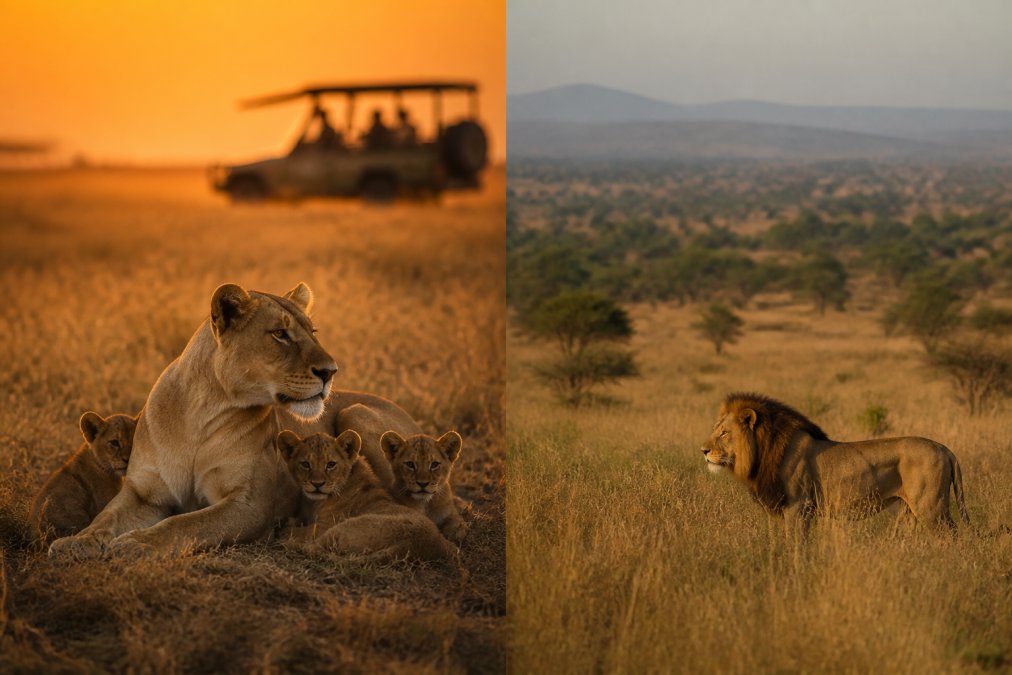
How the two parks differ at the species level
The Serengeti's predator density is driven by migratory herbivore biomass. When wildebeest and zebra are present, lion prides, cheetah, and spotted hyena follow the herds, and the Seronera Valley is one of Africa's most reliable places to see leopard draped in a sausage or fig tree by day. Cheetah favor the short-grass plains of the Serengeti and adjoining Ngorongoro Conservation Area, where their speed advantage is greatest.
Species you will see in one park and not the other
- Serengeti strengths: cheetah on open plains, large wildebeest and zebra concentrations during migration months, black rhino in the Moru Kopjes area (rare but possible), and the highest likelihood of a multi-predator day.
- Ruaha strengths: greater kudu, roan antelope, sable antelope, and a broader antelope diversity than the northern circuit. Ruaha is also one of the more dependable parks for African wild dog in the southern circuit.
- Both parks: lion, leopard, elephant, buffalo, giraffe, zebra, hippo, and crocodile.
Visibility mechanics: why density numbers can mislead you
A park can have more animals and still deliver fewer good sightings. In the Serengeti, short-grass plains and kopjes give long sightlines; a cheetah on a termite mound is visible from hundreds of yards. In Ruaha, miombo woodland, combretum bush, and riverine thickets break sightlines, you may drive past a leopard without knowing it.
Predator sighting probability by season
In the Serengeti, predator sightings peak when migratory herds are on the plains, roughly December through March in the south and east, and June through October in the western and northern corridors near the Mara River. Outside those windows, resident predators remain but the concentration effect fades.
The Great Migration vs Resident Game
The Great Migration is the Serengeti's headline act, a seasonal movement of wildebeest and zebra that draws predator action to the plains. Ruaha has no migration, but its resident game stays put year-round, so no month is wrong for a game drive.
What the Great Migration actually is
The Great Migration is not a single event. It is a roughly circular movement of more than a million wildebeest, several hundred thousand zebra, and accompanying gazelle through the Serengeti ecosystem and into Kenya's Maasai Mara. The herds follow rainfall and grass growth, so timing shifts by a few weeks each year.
A simplified annual pattern looks like this:
- December to March: The herds are on the short-grass plains of the southern and eastern Serengeti, calving in the south around February. This is when predator activity around newborn calves is highest.
- April to May: The long rains arrive and the herds begin moving west and north. This is the least predictable window and the quietest for tourism.
- June to July: The herds push north and west toward the Grumeti River and the western corridor. Grumeti River crossings happen in this window.
- July to October: The herds cross the Mara River into the Maasai Mara and back. This is the famous river-crossing window, and it is also the most crowded.
- November: The herds begin moving south again as the short rains arrive.
What "resident game" means in Ruaha
Ruaha has no migratory herds, so the wildlife you see in June is largely what you will see in February. Predators and herbivores are tied to permanent water, chiefly the Great Ruaha River, and move locally rather than continentally.
Biodiversity: where Ruaha actually wins
Ruaha sits in a transition zone between East African and southern African ecosystems, supporting species the northern circuit does not. Greater kudu, roan antelope, and sable antelope are Ruaha specialties. The park is also known for elephants and African wild dog, though wild dog sightings are never guaranteed.
The photography angle most guides skip
The two parks demand different camera kits.
- Serengeti: Open plains and long sightlines favor telephoto reach, a 400mm to 600mm lens is the workhorse. Dust, heat haze, and backlight at dawn and dusk are the main challenges. Wide-angle shots work for landscapes and for herds stretching to the horizon.
- Ruaha: Riverine bush and low-light conditions under canopy favor faster glass and higher ISO tolerance. Macro opportunities, insects, reptiles, baobab textures, are genuinely better in Ruaha than on the plains. Dawn and dusk game drives along the river are the strongest low-light shooting window.
If your portfolio leans toward wide-open plains and predator action, the Serengeti is the better canvas. If you want variety, macro, low-light, riverine, Ruaha gives you more range.
Big five mask. African Mask. Mask. →
Which one fits your trip
Choose the Serengeti if the migration is the reason you are traveling, if you have a short window and want maximum sightings per day, or if this is your first safari and you want the classic experience. Choose Ruaha if you want resident game you can plan around, species you cannot see in the north, and a photography environment with more variety and far less vehicle traffic.
Landscape, Scenery, and Safari Experience
The Serengeti offers iconic scenery: endless plains, granite kopjes, and acacia-dotted horizons. Ruaha trades that openness for dramatic riverine habitat, baobab-studded bushveld, and the Great Rift Valley escarpment.
Best Time to Visit Ruaha National Park
The best time to visit Ruaha National Park is the dry season, June through October, when vegetation thins and wildlife concentrates at water sources, making predator sightings and large elephant herds most reliable.
Accessibility, Logistics, and Tanzania Safari Itinerary Planning
Access differs sharply. The Serengeti connects to Arusha via domestic charter flights and road transfers through the Ngorongoro Conservation Area, folding easily into a northern circuit itinerary. Ruaha sits in the south, reached almost entirely by domestic charter from Dar es Salaam or Arusha.
Costs, Crowds, and Choosing Your Park
Costs track crowds. The Serengeti's peak-season demand pushes lodge and tented camp rates to the circuit's highest tier, with park fees per person per day. Ruaha's lower visitor numbers keep accommodation more available and often more affordable, though the required domestic charter can offset those savings.
Conclusion
Choosing between these two parks comes down to what you value most: the Serengeti's unmatched predator density and the Great Migration, or Ruaha's remote wilderness and low vehicle traffic. Whichever you choose, the experience is shaped by the operator behind it. Simcha African Safaris Limited offers expertly guided game drives in iconic national parks, combination safaris that include whale shark adventures, and flexible safari durations ranging from 3 to 7 days, all backed by access to UNESCO World Heritage sites.
Frequently Asked Questions
Which park has a higher wildlife density, Serengeti or Ruaha?
The Serengeti holds a higher overall wildlife density because of the Great Migration, when over a million wildebeest and hundreds of thousands of zebra move through the ecosystem. Ruaha has lower raw numbers but excellent predator density, especially lions and elephants, along the Great Ruaha River. If you want volume and variety, Serengeti wins; if you want intense predator action with fewer vehicles, Ruaha delivers.
Is Ruaha National Park better for predator sightings than the Serengeti?
Ruaha is known for strong lion and leopard sightings, often with fewer vehicles around a kill. The Serengeti offers higher predator numbers overall, particularly cheetah on the plains and river crossings that draw lions and crocodiles. For exclusive, unhurried predator viewing, Ruaha has the edge; for sheer predator density and dramatic river action, the Serengeti is hard to beat.
What is the best time to visit Ruaha National Park for wildlife viewing?
The dry season, from June through October, is the best time to visit Ruaha National Park. Wildlife concentrates around the Great Ruaha River and remaining water sources, making game drives more productive. The shoulder months of November and December bring short rains and fewer crowds, but some roads become difficult. Peak season offers the most reliable predator and elephant sightings.
How do costs compare between a Serengeti and a Ruaha safari?
Serengeti safaris generally cost more because of park fees, higher demand, and expensive domestic charter flights to Seronera or Kogatende. Ruaha can be more affordable on a per-day basis, though charter flights to Msembe still add up. Budget travelers should compare total logistics, not just daily rates.
Can I combine Serengeti and Ruaha in one Tanzania safari itinerary?
Yes, but it requires careful Tanzania safari itinerary planning. Most travelers fly from the Serengeti to Ruaha via Arusha or Dar es Salaam, which can take a full day. A 10-12 day trip allows 4-5 days in each park without rushing. If you have less than 8 days, pick one park and go deeper rather than splitting time between two distant ecosystems.


