

Table of Contents
- Why Booking Safely Matters More Than Price
- Step 1: Verify Kilimanjaro Climbing Safety Standards
- Step 2: Vet Operator Credentials and Financial Stability
- Step 3: Understand the Kilimanjaro Route Difficulty Comparison
- Step 4: Check the Kilimanjaro Guide-to-Client Ratio
- Step 5: Review Insurance and Emergency Evacuation Plans
- Step 6: Complete a Post-Booking Safety Checklist
- Final Step: Book With Confidence
- Frequently Asked Questions
Last Updated: September 9, 2026
Knowing how to book a Kilimanjaro climb safely is the single most important decision you will make about your expedition. Knowing the difference between a triumphant sunrise at Uhuru Peak and a tragic evacuation comes down to preparation done months before you set foot on the trail. This guide is an objective safety audit, not a sales pitch, designed to help you book a Kilimanjaro climb safely by focusing on operational details most commercial websites gloss over.
Why Booking Safely Matters More Than Price
The cheapest quote on the internet is often the most dangerous one. Kilimanjaro is a high-altitude trek where the mountain itself presents the primary risk, and cutting corners on oxygen support, guide training, or food quality can turn a manageable summit attempt into a medical emergency.
A responsible booking process verifies that your operator can handle the worst-case scenario, not just the sunny summit photo. Confirm emergency protocols, guide certifications, and equipment standards before you hand over a deposit. The quality of the response when a climber develops altitude sickness is what truly separates safe operators from risky ones.
Step 1: Verify Kilimanjaro Climbing Safety Standards
Kilimanjaro climbing safety standards begin with mandatory park requirements set by the Tanzania National Parks Authority. Confirm that your operator holds a valid license and that your lead guide is certified as a Wilderness First Responder, a benchmark for handling medical issues above 14,000 feet.
Ask pointed questions about emergency oxygen supply, portable hyperbaric chamber availability, and communication systems at high camp. A safe operator typically carries these items on every climb, not just on request. Also inquire about their evacuation plan and which rescue service they use.
Regulations exist, but enforcement varies, so your pre-booking research must verify compliance rather than assume it.
Step 2: Vet Operator Credentials and Financial Stability
Beyond safety certifications, vet the operator's financial health, because a company that goes bankrupt mid-season leaves you stranded. Ask how long they have been in operation and request references from recent climbers who completed the trek within the last year.
Financial stability matters for another reason: reputable operators pay their mountain crews fairly and on time. An operator struggling financially is more likely to underpay staff or cut corners on equipment. Look for operators who are members of the Kilimanjaro Porters Assistance Project or similar ethical tourism initiatives.
Step 3: Understand the Kilimanjaro Route Difficulty Comparison
The Kilimanjaro route difficulty comparison determines your acclimatization profile, the most critical factor in summit success. The Marangu route is the only route with hut accommodation, but its rapid ascent profile gives climbers a lower success rate, while the Machame and Lemosho routes offer better "climb high, sleep low" profiles.
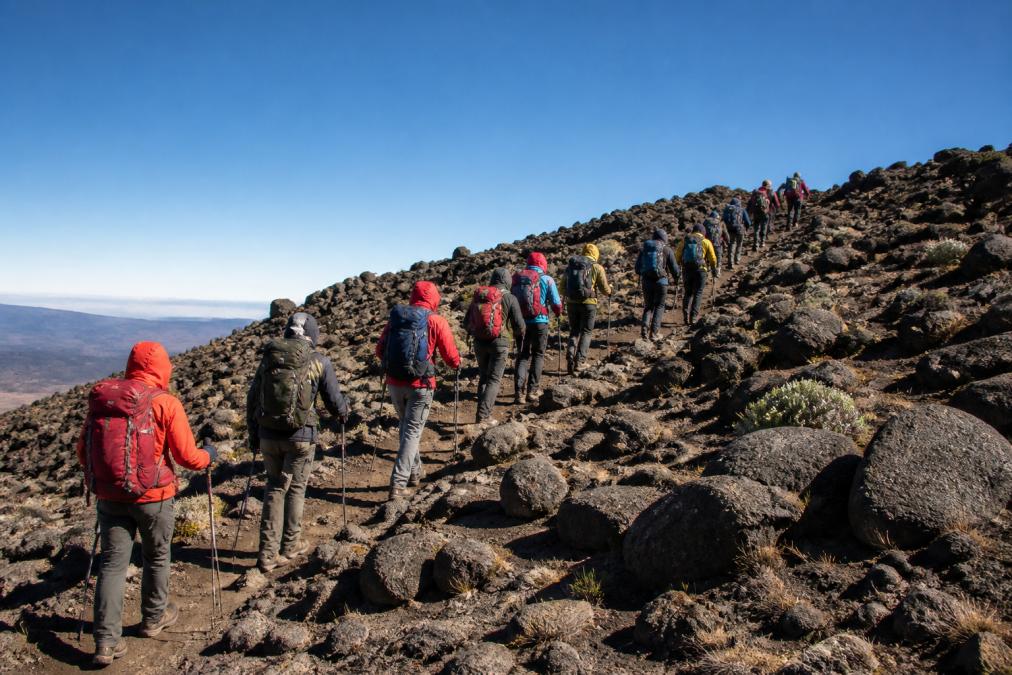
This is where the Kilimanjaro route difficulty comparison becomes a safety decision, not just a preference. The Lemosho route is longer and more expensive, but it provides superior acclimatization because you gain altitude more gradually. The Rongai route approaches from the north and is drier, but it has a less favorable acclimatization profile for many climbers.
| Route | Duration | Acclimatization Profile | Best For |
|---|---|---|---|
| Marangu | 5-6 days | Poor (rapid ascent) | Budget travelers, hut preference |
| Machame | 6-7 days | Good (climb high, sleep low) | First-time climbers seeking balance |
| Lemosho | 7-8 days | Excellent (longest approach) | Highest summit success rates |
When comparing routes, always prioritize the number of acclimatization days over the total trip length. A 7-day Lemosho climb is safer than a 5-day Marangu climb.
Step 4: Check the Kilimanjaro Guide-to-Client Ratio
The Kilimanjaro guide-to-client ratio directly impacts your safety, because a guide with too many clients cannot monitor each person's oxygen saturation effectively. While park regulations require a minimum ratio, safe operators exceed these standards by providing one assistant guide for every two to three climbers, plus a dedicated summit guide.
Ask for the specific ratio on your departure date, not the average across the company. A large operator might claim a good ratio on paper but consolidate groups at the last minute. Confirm that your group size is capped at a reasonable number.
Step 5: Review Insurance and Emergency Evacuation Plans
Standard travel insurance policies frequently exclude trekking above 4,000 meters, and even dedicated adventure policies often contain sub-limits that leave you with a five-figure bill. Before you book, verify three things: the altitude ceiling, the evacuation coverage limit, and the definition of 'emergency.'
Most climbers assume helicopter rescue is a single, all-inclusive event. In reality, a rescue on Kilimanjaro can involve multiple legs: a ranger-assisted descent, a road ambulance from the park gate, and a fixed-wing air ambulance to Nairobi or Dar es Salaam. Your policy needs to cover each leg, not just the helicopter. A common pattern is a policy that covers the helicopter but excludes the ground ambulance or hospital stay, which can cost more than the evacuation itself.
Ask your insurer for written confirmation on these specific points:
- Altitude ceiling: Does the policy cover you at 19,341 feet, or does it stop at 4,500 meters (14,764 feet)? Many policies cap coverage at 4,500 meters, which is below the summit.
- Evacuation benefit limit: Is there a cap on the evacuation benefit? A typical helicopter evacuation from Kilimanjaro costs between $15,000 and $30,000. If your policy caps evacuation at $10,000, you are personally liable for the difference.
- Rescue definition: Does the policy cover 'search and rescue' or only 'emergency evacuation'? These are different. Search and rescue covers the cost of finding you if you are lost; evacuation covers transport once you are found. On Kilimanjaro, where you are never truly lost, you need the evacuation coverage.
- Pre-existing conditions: Does the policy exclude altitude sickness if you have a history of asthma, high blood pressure, or other conditions? Some insurers require a 'fit to travel' letter from your physician for any pre-existing condition.
Your operator's emergency plan is the other half of this equation. A safe operator will have a written protocol that includes:
- Communication: Satellite phones or a messaging system that works above 14,000 feet. Cell service on Kilimanjaro is unreliable, and a guide relying on a cell phone is a red flag.
- Immediate response: A portable hyperbaric chamber (Gamow bag) on every climb. This device simulates descent and is the standard treatment for severe altitude sickness while you wait for evacuation.
- Evacuation coordination: A designated rescue service with a contract in place. Ask which company they use and whether that company has a helicopter based in Moshi or Arusha. A helicopter based in Nairobi adds 90 minutes of flight time to your rescue.
A final, often-overlooked detail: confirm that your operator carries a pulse oximeter for daily oxygen saturation checks. A reading below 75% at high camp is a sign to descend, and a guide who does not track this may not be following best practices (peer-reviewed research). Ask to see the device before you depart.
Your insurance and your operator's evacuation plan must work together. Before you pay your deposit, ask your insurer for written confirmation of your altitude coverage and your operator for a copy of their evacuation protocol. If either party hesitates, consider that a deal-breaker.
Step 6: Complete a Post-Booking Safety Checklist
Booking is not the finish line; it is the starting gun for a three-month preparation window. Safe operators actively prepare you. Your job is to verify that they are doing so. This checklist is designed to be executed in the 90 days before your departure.
90 Days Before Departure
- Confirm your operator's license and registration. You asked for this before booking. Now, verify it again. The Tanzanian government requires tour operators to hold a valid license from the Ministry of Natural Resources and Tourism. Ask for the license number and cross-reference it with the ministry's registry. A legitimate operator will provide this without hesitation.
- Request a written itinerary with named camps. Your operator should provide a day-by-day itinerary that includes the specific campsites and the altitude gain for each day. Cross-check this against the route's standard profile. If your itinerary shows a gain of more than 1,000 meters (3,280 feet) in a single day above 4,000 meters, that is a red flag for inadequate acclimatization.
- Book your flights with a buffer. Do not fly into Kilimanjaro International Airport the day before your climb starts. Flight delays and lost luggage are common. Arrive at least two days early to acclimatize to the altitude in Moshi or Arusha (elevation ~3,000 feet) and to recover from jet lag.
60 Days Before Departure
- Begin your physical training program. The summit night is a 6-to-8-hour continuous uphill push at altitude. Your training should mimic that demand. Focus on zone 2 cardiovascular work (long, steady efforts) three times per week, plus one day of strength training for your legs and core. A common pattern among successful climbers is to complete a 10-mile hike with a 20-pound pack on consecutive weekends, increasing the elevation gain each time.
- Schedule a medical checkup. Visit your physician for a high-altitude trekking consultation. Discuss any pre-existing conditions and ask about acetazolamide (Diamox), the medication commonly used to prevent altitude sickness. Your doctor can prescribe it and advise on dosage. Do not self-medicate.
- Verify your vaccinations. Tanzania requires a yellow fever certificate for entry if you are arriving from a country with risk of yellow fever transmission (the CDC). Check the CDC's current requirements, and confirm that your routine vaccinations (tetanus, hepatitis A and B, typhoid) are up to date.
30 Days Before Departure
- Request a detailed gear list from your operator. A safe operator will provide a comprehensive packing list that includes specific items for high altitude: a 4-season sleeping bag rated to -20°F, insulated boots, and layered clothing systems. Compare this list against your own gear. If your operator does not provide a list, that is a sign they are not managing your preparation.
- Confirm your guide-to-client ratio in writing. You discussed this before booking. Now, ask for written confirmation of the ratio for your specific departure date. A safe operator will confirm that your group has a lead guide, an assistant guide for every three clients, and a dedicated summit guide.
- Purchase your travel insurance. Do not wait until the last minute. Buy a policy that explicitly covers high-altitude trekking above 5,000 meters, and confirm that the evacuation benefit is at least $50,000. Keep a digital copy of your policy on your phone and a printed copy in your daypack.
7 Days Before Departure
- Test your gear. Break in your boots with a final 5-mile hike. Test your headlamp batteries, your water filtration system, and your trekking poles. Pack your bag and weigh it. Your total pack weight should not exceed 15% of your body weight for the trekking portion, as porters will carry the bulk of your gear (the CDC).
- Confirm your operator's emergency contact. Ask for the 24-hour emergency phone number for the operator's office in Moshi. Save this number in your phone and share it with a family member at home. Also, confirm that your guide has a satellite phone or an alternative communication device for use above 14,000 feet.
- Review your acclimatization plan. Your operator should have a 'climb high, sleep low' itinerary. Confirm that your summit day starts early (around midnight) and that you have a mandatory rest day at a high camp before the summit push. If your itinerary does not include a rest day above 4,000 meters, question it.
Your preparation is a partnership. The operator provides the infrastructure, the permits, and the guides. You provide the physical conditioning, the right gear, and the discipline to follow the plan. Completing this checklist does not guarantee a summit, but it dramatically reduces the risk of a preventable failure or medical emergency.
Final Step: Book With Confidence
Understanding how to book a Kilimanjaro climb safely is a process of verification, not just selection. You now have the tools to audit an operator's safety standards, compare route difficulty, confirm guide ratios, and review emergency plans. Applying these checks will dramatically reduce your risk of a failed or dangerous summit attempt.
At Simcha African Safaris Limited, we offer expertly guided game drives in iconic national parks and curated Tanzania safari experiences, including exhilarating Mount Kilimanjaro hikes on routes like Lemosho and Machame that maximize acclimatization. We also offer curated safari extensions and handcrafted authentic African art to commemorate your journey, so your adventure can continue beyond the mountain. Contact us to request a quote and start planning an expedition where safety and summit success go hand in hand.
Frequently Asked Questions
What safety certifications should a Kilimanjaro operator have?
Look for operators registered with the Tanzania Tourist Board and members of the Kilimanjaro Association of Tour Operators. Ask for proof of wilderness first responder training for guides and verify they have emergency oxygen and a pulse oximeter on every climb. A reputable operator will share these credentials without hesitation.
Is it better to book a Kilimanjaro climb in person or online?
Booking online through a reputable operator is standard and safe, provided you do your due diligence. Verify the company's physical address, read independent reviews, and confirm your booking deposit is protected by a clear cancellation policy. Booking in person in Moshi or Arusha on arrival is risky because reputable operators plan routes and permits months ahead, leaving you with limited options.
How does the Kilimanjaro guide-to-client ratio affect safety?
The guide-to-client ratio directly affects your safety. A ratio of 1:2 or better ensures you get individual attention for acclimatization monitoring and early signs of altitude sickness. Ask for the ratio in writing before you book. If an operator plans for one guide per four or more climbers, your safety monitoring will be stretched thin, especially on summit night when conditions are hardest.
What is the safest Kilimanjaro route for a first-time climber?
The Lemosho route is widely considered the safest for first-time climbers due to its longer itinerary, which allows for better acclimatization. The Marangu route is shorter but has a lower summit success rate because of its rapid ascent profile. When comparing routes, prioritize those with at least seven days of climbing to give your body time to adjust to the altitude safely.
Booking your climb is the first step of the journey, and doing it safely requires the same care you will bring to the mountain itself. Trust the operator that treats safety as a non-negotiable standard, not a marketing slogan. Get started with Simcha African Safaris Limited and turn your Kilimanjaro dream into a safe, successful reality.


